

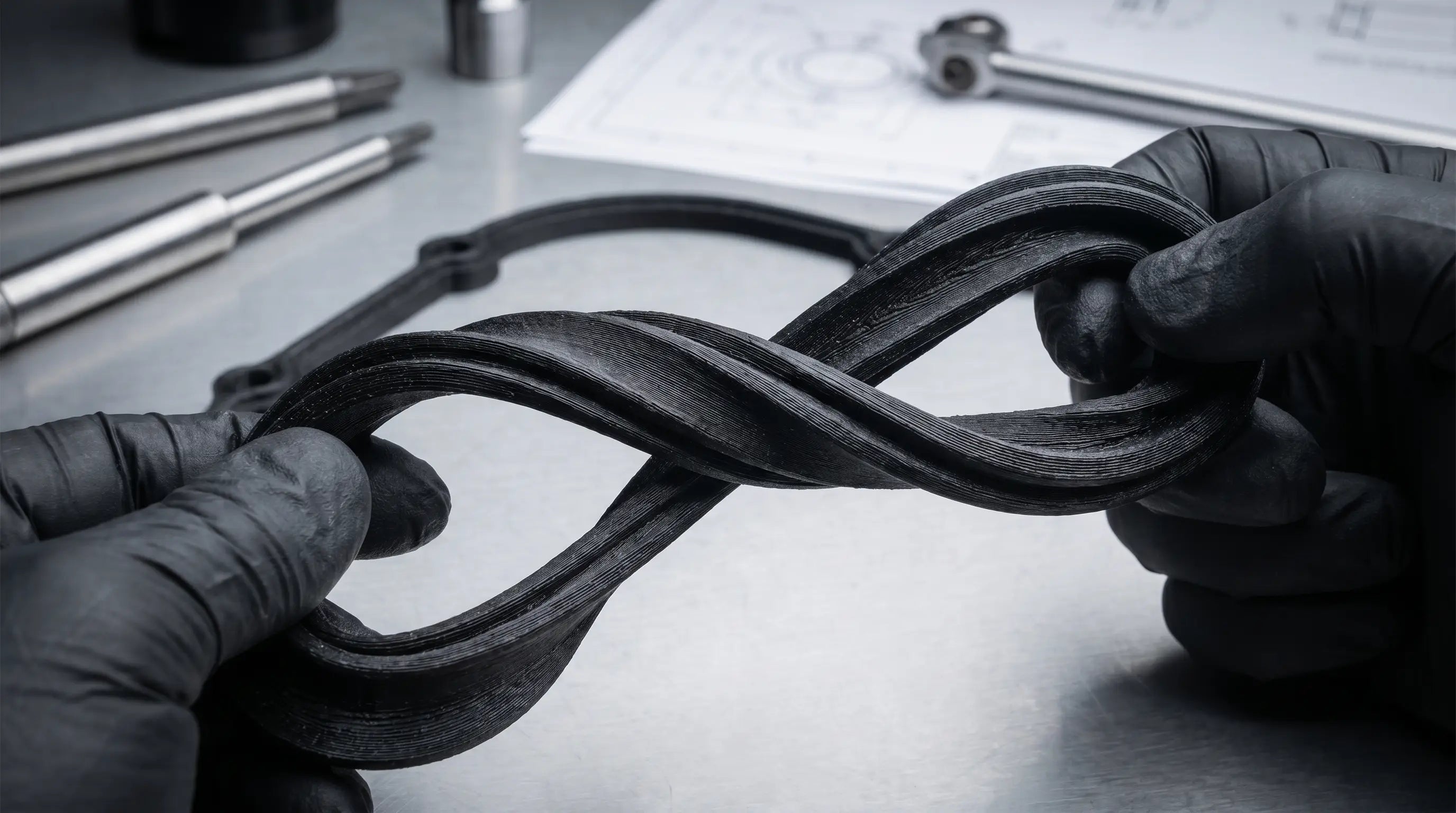
- TPU (thermoplastic polyurethane) is a rubber-like FDM filament with high flexibility, abrasion resistance and chemical resistance
- We print with TPU 95A (soft and flexible) and TPU 65D (semi-rigid) — both ready for industrial and commercial applications
- The right choice for gaskets, seals, shock absorbers, anti-slip surfaces and flexible industrial parts
- No minimum order — from 1 prototype to series production with delivery in 2–5 business days
- Quote within 24 hours: upload your STL file via the enquiry form
TPU material is the answer when your design requires something that can both bend and hold. As one of the most widely used technical FDM filaments in industry, TPU combines rubber's flexibility with plastic's precision — and at Maker Factory we can print complex TPU parts with tolerances down to ±0.3 mm and deliver them within a few business days.
On this page we cover when TPU is the right choice, which TPU variants we work with, and what it typically costs to have flexible industrial parts printed with us.
Read more about our other 3D printing services or go directly to our TPU 95A material page and TPU 65D material page for technical specifications.
What is TPU material?
TPU — thermoplastic polyurethane — is an elastic plastic type that combines the properties of rubber and thermoplastic. The material can be deformed repeatedly without losing its shape, withstands shocks and vibrations well, and is chemically resistant to oil, grease and many solvents.
In FDM 3D printing, TPU is used as a filament with a diameter of 1.75 mm. The printing process requires a well-tuned extruder and lower print speed than standard PLA or PETG, but in return it gives access to a material class for which injection moulding is normally the only solution. With 3D printing in TPU you can produce one piece or one hundred — with the same setup and without tooling costs.
Shore hardness is the most important parameter to know. The lower the Shore A value, the softer and more flexible the material. TPU 95A is noticeably softer than TPU 65D, which approaches a semi-rigid plastic material with a degree of flex.
When do you choose TPU over other materials?
TPU is not the universal answer to all printing tasks — but it is the obvious choice in specific situations. Here are the three scenarios where we consistently recommend TPU over PETG, PLA or PA6-CF:
Gaskets and seals — rapid replacement of discontinued parts
Machine manufacturers and production companies regularly encounter situations where a gasket or seal has been discontinued by the supplier — or simply has a lead time of 6–12 weeks. With a CAD file or measurements from the original part, we can print a functional TPU replacement within 2–3 business days.
TPU withstands repeated compression and returns to its original shape, making it suitable as a sealing material in non-critical pneumatic and hydraulic systems. The material is chemically resistant to most industrial lubricants and oils, and can be printed with infill and wall thickness tailored to the desired compression level.
Shock absorbers and vibration isolators in industry
Vibrations from motors, pumps and conveyor belts reduce the lifespan of adjacent components and create noise problems. Traditionally this is solved with moulded rubber parts — but tooling costs are high and lead times long, particularly for non-standard geometries.
3D-printed TPU shock absorbers solve this by providing full design freedom. We can print complex geometries with varying wall thickness that provide precisely the stiffness and damping capacity the task requires. Gyroid and honeycomb infill structures are used to adjust the mechanical response without changing the outer dimensions.
Flexible prototypes and functional parts for testing and validation
When a new product needs to be validated — and the final production is planned in moulded rubber or silicone — a 3D-printed TPU part is the fastest and cheapest step to confirming design and fit. TPU prototypes give a realistic impression of the material's behaviour in use, and any design changes can be implemented from one day to the next.
We have helped companies in medical devices, toy design and industrial design validate flexible components in TPU before they invested in expensive tooling or moulding processes.
- You need a flexible part that can bend and return to its shape
- You need to replace a discontinued gasket or seal quickly and without tooling costs
- Your design requires shock absorption, vibration isolation or anti-slip surfaces
- You want to prototype a rubber part before investing in injection or compression moulding
- The part must withstand repeated mechanical load without cracking or permanently deforming
If you need a rigid, structural material for jigs, fixtures or heavily loaded machine parts, PETG or PA6-CF is better suited. TPU is primarily the choice when flexibility and elasticity are essential.
TPU 95A and TPU 65D — differences and selection
At Maker Factory we work with two TPU variants with different Shore hardness. The choice between them depends on how soft or rigid the finished part needs to be.
| Property | TPU 95A | TPU 65D |
|---|---|---|
| Shore hardness | 95A (soft/flexible) | 65D (semi-rigid) |
| Elongation at break | ~580% | ~300% |
| Tensile strength | ~39 MPa | ~52 MPa |
| Max. operating temperature | ~80°C | ~90°C |
| Chemical resistance | Good (oil, grease, weak acids) | Good (oil, grease, weak acids) |
| Typical applications | Gaskets, grip covers, seals, shock absorbers | Wheels, semi-rigid profiles, protective parts |
| UV resistance | Limited | Limited |
As a rule of thumb: choose TPU 95A for anything that needs to feel soft and flexible — gaskets, seals, grip covers and shock absorbers. Choose TPU 65D when you need a degree of rigidity combined with flex.
Comparison: TPU vs. PETG, PA6-CF and PLA
| Material | Flexibility | Stiffness | Heat resistance | Best for |
|---|---|---|---|---|
| TPU 95A | ★★★★★ | ★☆☆☆☆ | Up to 80°C | Gaskets, seals, shock absorbers |
| TPU 65D | ★★★☆☆ | ★★★☆☆ | Up to 90°C | Wheels, semi-rigid profiles |
| PETG | ★☆☆☆☆ | ★★★☆☆ | Up to 80°C | General industrial parts, enclosures |
| PA6-CF | ★☆☆☆☆ | ★★★★★ | Up to 180°C | Jigs, fixtures, heavily loaded parts |
| PLA | ★☆☆☆☆ | ★★☆☆☆ | Up to 60°C | Prototypes, models, low load |
We printed a series of TPU 95A gaskets for a machine manufacturer in West Jutland. The original gasket had been discontinued by the supplier with a new lead time of 8 weeks. We received measurements from the worn original part, modelled it in Fusion 360 and delivered 12 functional gaskets within 3 business days. The cost was a fraction of what it would have taken to produce new tooling.
Typical tasks we solve with TPU 3D printing
- Replacement gaskets and seals for production companies — particularly for discontinued or custom-dimensioned parts
- Shock absorbers and vibration isolators for machines, pumps and motors
- Grip covers and anti-slip surfaces for hand tools, medical devices and consumer electronics
- Flexible hoses and cable grommets for electronics and technology applications
- Protective sleeves and bumpers for equipment exposed to impacts and drops
- Wheels and rollers for transport carts — TPU 65D provides good wear resistance and damping
- Prototyping rubber parts for validation before investing in moulding
What does TPU 3D printing cost at Maker Factory?
The price depends primarily on the part's volume, weight, print time and any post-processing. TPU requires a slower print speed than PLA and PETG to ensure consistent quality.
- Small parts (under 50 cm³) — typically DKK 150–400 per piece
- Medium parts (50–200 cm³) — typically DKK 300–900 per piece
- Series (10+ pieces) — volume discount applies from 5 pieces
Get your TPU parts printed at Maker Factory — quote within 24 hours
Send enquiry →FAQ about TPU 3D printing
Is TPU the same as rubber?
TPU resembles rubber in behaviour — it is flexible, elastic and withstands repeated deformation. But TPU is a thermoplastic, not vulcanised rubber. It can be melted and reused, and is printed with FDM technology. For most industrial replacement purposes, TPU works as a practical alternative to moulded rubber.
Can TPU-printed parts be used in wet environments?
Yes. TPU has good water resistance and is not hygroscopic during use. Parts printed in TPU can be used in humid environments and exposed to weak acids and bases. They should not be used in contact with strong solvents or at temperatures above 80–90°C continuously.
What is Shore hardness, and which should I choose?
Shore hardness is a scale for material softness. TPU 95A is noticeably softer than a rubber sole, while TPU 65D approaches a hard plastic-rubber. Choose 95A for gaskets and grip parts, 65D when you need more structural stability while retaining flex.
Can TPU-printed parts be post-processed?
TPU is more difficult to post-process than PLA and PETG. It can be painted with flexible surface treatments designed for rubber and elastomers. For most industrial purposes, TPU parts are delivered in raw print quality with support structures removed.
What is the delivery time for TPU printing?
Standard delivery time is 2–5 business days from approved order confirmation. We offer express production in 1–2 business days when needed. Delivery is via PostNord or GLS to all of Denmark.
How large a part can you print in TPU?
Our FDM printers have a print volume of up to 350 × 350 × 350 mm depending on machine type. Larger parts can be split and joined afterwards.
Do you offer an NDA for confidential projects?
Yes. We offer confidentiality agreements for business customers. Contact Henrik Beck directly at h.beck@makerfactory.dk to agree terms before submitting files.
Share:
3D printing in Copenhagen — online 3D printing service with delivery throughout Denmark
PETG-CF 3D printing — carbon fibre reinforced for jigs and fixtures