

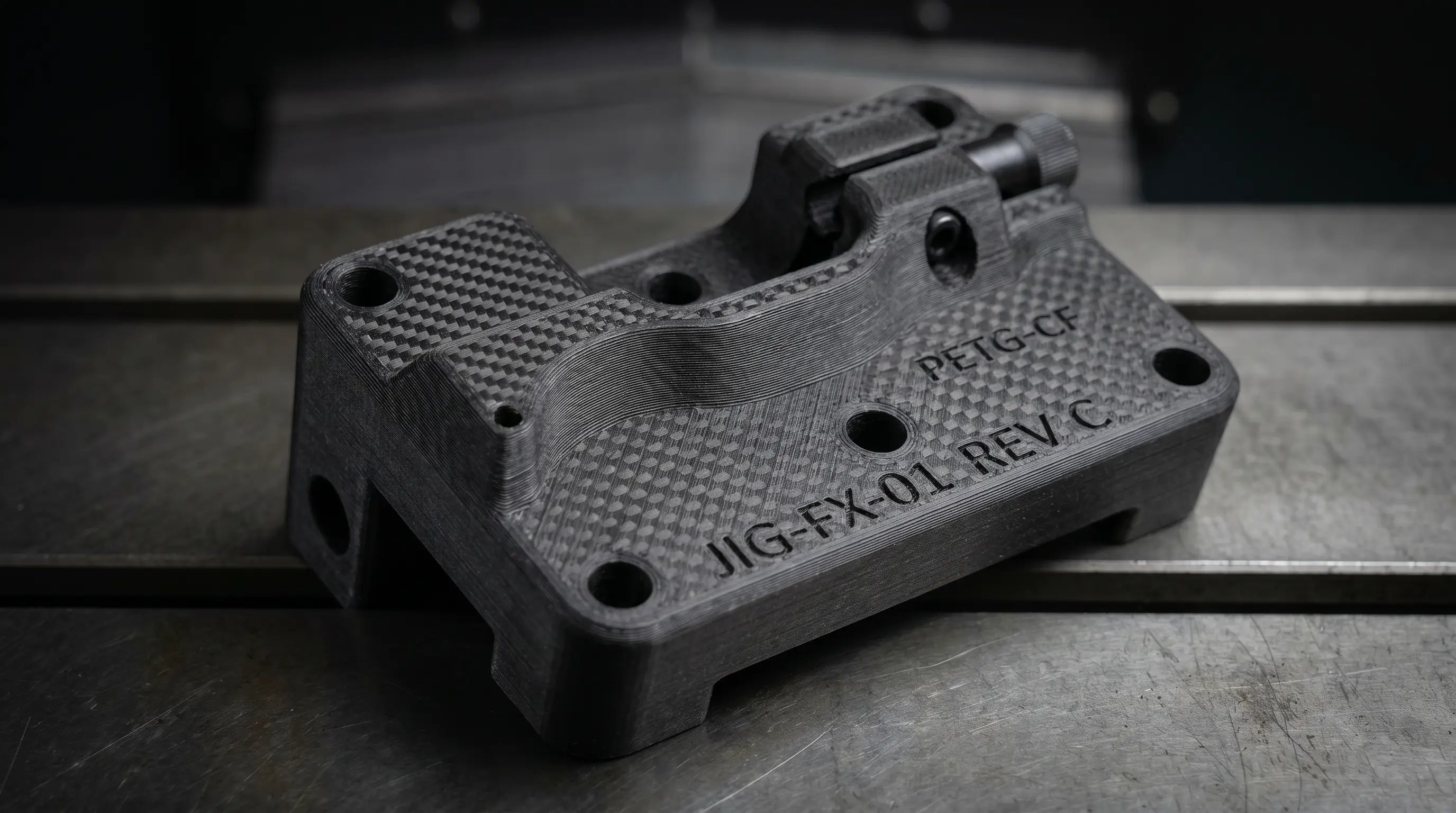
- PETG-CF is carbon fibre reinforced PETG — significantly stiffer and stronger than standard PETG, without the printing challenges of PA6-CF
- Tensile strength up to ~80 MPa and E-modulus ~6,000 MPa — ideal for precision jigs, fixtures and structural industrial parts
- No heated enclosure required — lower production cost and shorter lead time than PA6-CF
- Good chemical resistance to oil, grease and weak acids — suitable for production environments
- Delivery in 2–5 business days — quote within 24 hours via the enquiry form
PETG-CF is the material that combines PETG's printability and chemical resistance with carbon fibre's stiffness — and the result is a technical FDM filament that solves an entire category of industrial tasks that standard PETG simply is not strong enough for. At Maker Factory we print PETG-CF for jigs, fixtures, welding templates and structural components that require high stiffness and dimensional stability.
On this page we cover when PETG-CF is the right choice, what technical properties the material has, and what it costs to have PETG-CF printed with us.
Read more about our standard PETG material, our PETG-CF material page with technical data sheet, or our broad 3D printing service for business and private customers.
What is PETG-CF?
PETG-CF — carbon fibre reinforced PETG (polyethylene terephthalate glycol) — is a composite type where short carbon fibre particles are blended into the PETG matrix. The carbon fibre acts as reinforcement: it significantly increases the material's stiffness and tensile strength, while the PETG base contributes chemical resistance, low shrinkage and good layer adhesion.
Compared to pure PETG, PETG-CF is typically 40–60% stiffer and has noticeably better dimensional stability — meaning that PETG-CF parts retain their shape and dimensions better under mechanical load and temperature variation. This makes the material well suited for production tooling, assembly jigs and other parts used in repetitive workflows that must maintain stable tolerances over time.
An important practical point: PETG-CF can be printed on standard FDM printers with a hardened steel nozzle — it requires neither a heated enclosure nor special configuration, as PA6-CF does. This means shorter setup time and lower cost per part, making PETG-CF the preferred choice when PA6-CF's extreme properties are not necessary.
When do you choose PETG-CF over other materials?
PETG-CF is not the right choice for all tasks — but it is the obvious choice in specific scenarios where pure PETG is too soft, PA6-CF is over-specified, and PLA is too brittle. Here are the three primary use cases:
Precision jigs and welding fixtures for series production
A welding fixture must hold parts in an exact position, time after time, under heat and mechanical load. Traditionally these are made in steel or aluminium — but for many geometries and production volumes, PETG-CF 3D printing is a faster and cheaper alternative that provides sufficient stiffness and dimensional stability.
PETG-CF's high E-modulus (stiffness) means fixtures retain their shape and dimensions even under repeated use. The material tolerates brief heat exposure from adjacent welding operations and is not hygroscopic to the same degree as PA6-CF — it absorbs very little moisture and does not change dimensions over time. We have delivered PETG-CF welding fixtures to machine companies that replace aluminium fixtures with 2–4 week lead times with 3D-printed alternatives ready in 3 business days.
Assembly tools and process jigs for industrial lines
Production lines require a wide range of special tools and aids: depth stops, positioning plates, assembly guides and inspection gauges. These require high precision and good wear resistance, but rarely the full strength of metal. PETG-CF hits this middle ground precisely.
The advantage of 3D printing in PETG-CF is that special tools can be designed and produced in days rather than weeks. If a jig wears down or the design needs to change, revision time is minimal — there are no moulds to edit, no minimum quantities to order. We often see production companies use PETG-CF as a step from prototype jigs to actual production tooling, because the material holds up for thousands of cycles under normal working loads.
Structural components requiring low weight and high stiffness
In applications where weight is a factor — drone frames, robot arms, load-bearing structures in machines — PETG-CF offers a favourable strength-to-weight ratio compared to metal. Density is approximately 1.24 g/cm³, far below aluminium (2.7 g/cm³) and steel (7.8 g/cm³), while stiffness is significantly higher than standard plastics.
For components not exposed to temperatures above 75–80°C, and that do not require PA6-CF's extreme tensile strength, PETG-CF is a more printable and cost-effective choice. Complex geometries that would require expensive CNC milling in metal can be printed in PETG-CF with the same day-to-day flexibility as standard FDM printing.
- You need a stiff, precise jig or fixture for series production
- Standard PETG is too soft, but PA6-CF is over-specified for your application
- The part must withstand repeated mechanical load without deforming
- You want to save time and money compared to CNC milling in aluminium
- The operating temperature does not exceed 75–80°C continuously
If your application requires temperatures above 80°C, extreme tensile strength or high wear resistance under abrasive conditions, PA6-CF is the right choice. PA6-CF withstands up to 180°C and has a tensile strength of ~170 MPa compared to PETG-CF's ~80 MPa. For most jig and fixture tasks, however, PETG-CF is sufficient and easier to produce.
Technical specifications for PETG-CF
| Property | Value | Note |
|---|---|---|
| Tensile strength | ~80 MPa | Approx. 60% above standard PETG |
| E-modulus (stiffness) | ~6,000 MPa | Significantly stiffer than PETG (~2,100 MPa) |
| Density | ~1.24 g/cm³ | Light material — low strength-to-weight penalty vs. metal |
| Max. operating temperature | ~75–80°C | Short-term exposure up to 90°C possible |
| Chemical resistance | Good | Resistant to oil, grease and weak acids |
| Hygroscopicity | Low | Absorbs minimal moisture — stable dimensions over time |
| Surface texture | Matte, textured | Carbon fibre particles give characteristic appearance |
| Requires heated enclosure | No | Can be printed on standard FDM printers with hardened nozzle |
Comparison: PETG-CF vs. PETG, PA6-CF and PLA
| Material | Tensile strength | Stiffness | Max. temp. | Best for |
|---|---|---|---|---|
| PETG-CF | ~80 MPa | ★★★★☆ | 75–80°C | Jigs, fixtures, assembly tools |
| PETG | ~50 MPa | ★★☆☆☆ | 75–80°C | General industrial parts, enclosures |
| PA6-CF | ~170 MPa | ★★★★★ | 180°C | Heavily loaded structures, high heat |
| PLA | ~60 MPa | ★★☆☆☆ | 60°C | Prototypes, models, non-structural |
| TPU 95A | ~39 MPa | ★☆☆☆☆ (flex) | 80°C | Gaskets, shock absorbers, flexible parts |
A machine company contacted us needing a welding fixture for holding two steel profiles during MIG welding. The existing aluminium jig was worn out and the lead time for a new one was 3–4 weeks. We received the original's measurement sketch, modelled the fixture in Fusion 360 and delivered a PETG-CF fixture within 2 business days. The customer ran it through 400 welding cycles without noticeable deformation — and subsequently ordered two further variants for different profile dimensions.
Typical tasks we solve with PETG-CF 3D printing
PETG-CF is used across a broad spectrum of industrial and technical applications where precision and stiffness are critical. The most common task types we solve:
- Welding fixtures and positioning jigs for machine building and automation — holds parts in exact position during production
- Control gauges and inspection tools for quality assurance — verifies dimensions and tolerances in ongoing production
- Assembly guides and depth stops for assembly-line production — reduces mis-assembly and increases efficiency
- Structural brackets and load-bearing profile segments for industrial applications with low-to-medium loading
- Drone frames and robot components requiring a low strength-to-weight ratio
- Cable channels and EMI shielding frames for electronics and technology
- Replacement parts for machinery with short lead times — from CAD file to delivery in 2–3 business days
What does PETG-CF 3D printing cost at Maker Factory?
The price of PETG-CF printing depends on the part's geometry, volume and the required infill density. PETG-CF is slightly more expensive than standard PETG as a filament and requires a hardened nozzle — but is significantly cheaper to produce than PA6-CF, which requires a heated enclosure and more specific machine configuration.
- Small jigs and fixtures (under 100 cm³) — typically DKK 200–500 per piece
- Medium parts (100–400 cm³) — typically DKK 400–1,200 per piece
- Series (5+ pieces) — volume discount — contact us for series quotes
We always adapt infill percentage, wall thickness and print orientation to the specific loading direction for your part. The wrong print orientation can halve the effective strength — we design with this in mind from the start.
Get a quote for PETG-CF printing — upload your STL and receive a response within 24 hours
Send enquiry →FAQ about PETG-CF 3D printing
What is the difference between PETG-CF and standard PETG?
PETG-CF contains short carbon fibre particles that increase the material's stiffness and tensile strength by 40–60% compared to pure PETG. The base is the same polymer type, so chemical resistance and low hygroscopicity are retained. PETG-CF is however slightly more brittle than PETG under extreme bending — it is a stiffer, not a tougher, material.
Does PETG-CF require a heated enclosure?
No — this is one of PETG-CF's most important practical advantages over PA6-CF. PETG-CF can be printed on standard FDM printers with a hardened steel nozzle (necessary due to carbon fibre's abrasiveness). This means lower production cost and shorter lead time than PA6-CF, which requires a closed, heated enclosure.
Can PETG-CF be used for welding fixtures?
Yes, in many cases. PETG-CF tolerates brief heat exposure from adjacent welding operations and has sufficient stiffness to hold parts in an exact position. It is not suitable for direct contact with welding heat or for applications continuously exposed to temperatures above 80°C. For these purposes we recommend PA6-CF or a metal-based alternative.
What is PETG-CF's chemical resistance?
PETG-CF inherits PETG's good chemical resistance: the material resists oil, grease, alcohol and weak acids well. It is not resistant to strong oxidising acids, ketones (e.g. acetone) or chlorinated solvents. For most industrial production environments, the chemical resistance is sufficient.
Can PETG-CF be printed in complex geometries?
Yes. PETG-CF is printed as standard FDM with support structures removed after printing. Complex internal channels, undercuts and fine details are possible, albeit with the usual FDM limitations for hanging overhangs. We are happy to advise on design optimisation if you send your STL file.
Can PETG-CF be replaced by standard PETG to save money?
It depends on the task. For decorative or lightly loaded parts, standard PETG is a cheaper and fully adequate alternative. For jigs, fixtures and structural components with stiffness and dimensional stability requirements, PETG-CF is clearly the better choice — and the price difference is typically 20–40% per part, which is quickly recovered through reduced mis-assembly or re-inspection costs.
Which print orientation is best for PETG-CF parts?
Print orientation significantly affects a part's effective strength. Carbon fibre is oriented along the print direction (X/Y plane), giving high strength in these directions but lower strength in the Z direction (layer-to-layer). We always arrange the print orientation so that the primary load vectors in your application are parallel to the X/Y plane. Send your load requirements with the enquiry so we can optimise the setup.
Share:
TPU 3D printing — flexible material for gaskets and industrial parts
3D print post-processing — sanding, painting and surface treatment