

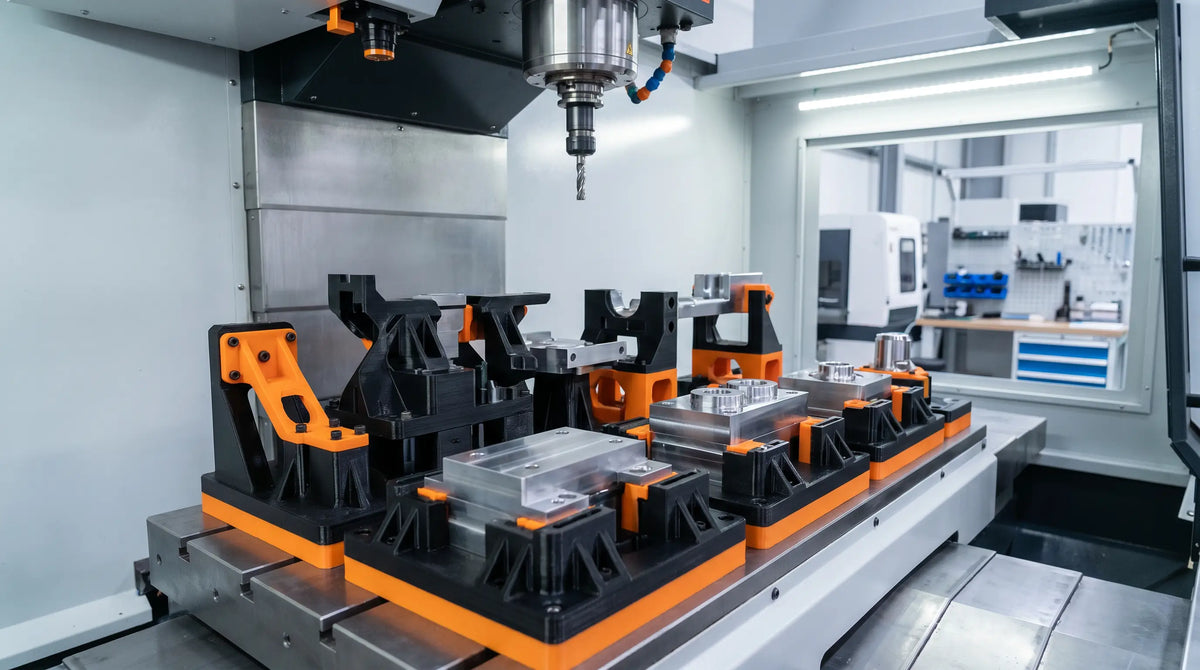
3D printed jigs and fixtures — faster and cheaper than CNC
- 3D printed jigs and fixtures cost 5–20× less than CNC-machined aluminum and are ready in 2–5 days
- PA6-CF and PETG-CF are the preferred materials — stiff, lightweight, and heat-resistant
- Useful for assembly lines, welding jigs, inspection fixtures, and assembly aids
- We design and print jigs from sketch to delivered part — the whole process at Maker Factory
- Tolerances: FDM ±0.2 mm as standard — refined to ±0.1 mm for critical fits
3D printed jigs and fixtures are one of the fastest-growing applications of additive manufacturing in Danish industry. They let manufacturing companies replace expensive, slow CNC machining processes with quickly produced plastic tools in technical materials. Here's everything you need to know about using 3D printing for production aids.
What are jigs and fixtures — and what's the difference?
In industrial production, the terms jig and fixture are often used interchangeably, but technically they serve different functions:
A jig is a tool that guides another tool to the correct position — for example, a drill jig that holds a drill precisely over the correct drilling point on a part. The jig moves with the part and controls the geometry of the process.
A fixture holds a part firmly in a precise position during machining, assembly, or inspection — but doesn't guide the tool itself. A welding fixture holds two metal profiles at the correct angle while they're welded together.
In practice, both terms are used interchangeably to mean production aids that increase precision, speed, and repeatability in a production process.
Advantages of 3D printed jigs and fixtures
Price and time — the decisive difference
The traditional way to produce jigs is CNC machining in aluminum or steel. This gives high durability and precision, but at a price and lead time that makes it uneconomical for many applications. A simple aluminum jig with 2–3 positioning points typically costs DKK 3,000–8,000 and has a 3–6 week lead time from a machine shop.
The same jig 3D printed in PA6-CF costs DKK 300–1,200 and is ready in 2–5 days. That's a saving of 70–85% in material costs and an 80–95% shorter lead time. For prototype jigs and low-volume production, the math is clear.
Design freedom and fast iteration
3D printing offers design freedom that CNC can't match. Internal channels, integrated clip features, ergonomic grips, and complex positioning points can be designed and printed at no extra cost. When a jig turns out to have a flaw or the product changes, we print a new version — not a new CNC run. We have customers who iterate jig designs 3–5 times before locking the design.
Light weight
PA6-CF weighs 1.10 g/cm³ vs. aluminum's 2.7 g/cm³. A 3D printed jig typically weighs 40–60% of an equivalent aluminum jig. That reduces operator fatigue in manual assembly lines and eases the handling equipment that needs to move the jig.
- You need the jig quickly (2–5 days vs. 3–6 weeks)
- The product design can still change and the jig needs to be iterated
- Production volume is low to medium (under 100,000 operations per year)
- Complex geometry that would be expensive to CNC machine
- The jig is used in heavy machining processes (turning, milling) with large cutting forces
- The temperature continuously exceeds 130°C
- Tolerance requirements are under ±0.05 mm
- Production volume is over 500,000 operations with physical wear
A Danish electronics manufacturer previously used aluminum inspection fixtures for PCB checks — 3 units at DKK 6,000 each, DKK 18,000 total. The product design changed quarterly, requiring new fixtures each time. We now print PETG-CF fixtures at DKK 600 each, and we can deliver updated versions within 4 days. Savings in the first year: around DKK 60,000.
Materials: PA6-CF, PETG-CF, and more
The choice of material for 3D printed jigs and fixtures depends on load, temperature, and chemical environment:
| Material | Tensile strength | Max. temp. | Best for |
|---|---|---|---|
| PA6-CF | 80–110 MPa | 120–130°C | Welding jigs, high-temp fixtures, industrial jigs |
| PETG-CF | 55–70 MPa | 85–90°C | Assembly jigs, PCB fixtures, assembly aids |
| ASA | 40–50 MPa | 95–100°C | Outdoor jigs, UV-exposed positioning fixtures |
| PETG standard | 45–55 MPa | 75–80°C | Lightly loaded jigs, prototype fixtures |
| Spec | PA6-CF FDM jig | Aluminum CNC jig |
|---|---|---|
| Lead time | 2–5 days | 3–6 weeks |
| Price (typical simple jig) | DKK 300–1,200 | DKK 3,000–8,000 |
| Standard tolerance | ±0.2 mm | ±0.05 mm |
| Weight (200 cm³ part) | ~220 g | ~540 g |
| Iteration cost | Full new price (low) | Full new CNC run |
When isn't 3D printing enough?
3D printing isn't the universal answer. There are situations where metal is the right choice:
Heavy machine operations with large forces
Milling, turning, and other heavy machining processes generate cutting forces that can deform even stiff plastic materials. PA6-CF is stiff, but has 1/10 the elastic modulus of aluminum. For jigs held fixed in a CNC machine during machining, metal remains the standard.
Extreme tolerances under ±0.05 mm
FDM's tolerance is typically ±0.2 mm as standard. We can improve this to ±0.1 mm with careful calibration and material choice, but below ±0.05 mm requires jig grounding (metal inserts) or SLA/resin printing. Contact us for advice on precision jobs.
Continuous temperature above 130°C
PA6-CF's heat deflection temperature is 120–130°C. Operation above this level requires PC (polycarbonate) or a metal fixture. For welding processes that generate localized heat, we can design ventilation channels that direct heat away from the plastic material.
Design tips for 3D printed jigs and fixtures
Designing a good 3D printed jig requires understanding 3D printing's limitations and strengths. Here are the key principles we apply:
Orient for optimal strength
In FDM printing, strength is lower in the Z direction (the layer direction) than in the XY plane. Critical positioning features and load-bearing cross-sections should be designed to lie in the XY plane. A jig that's primarily loaded horizontally can be printed flat for maximum strength — a jig loaded vertically may require redesigning the layout or extra wall thickness.
Integrate metal inserts for screw connections
Screw holes in plastic wear over time. We always recommend thermal inserts (M3–M8) for screw connections that are opened and closed regularly. These are melted into the plastic with a soldering iron and provide metal-to-metal connections with a long service life. Add-on cost: DKK 15–40 per insert depending on size.
Build volume and split design
Our FDM printers have a maximum build volume of 350×350×350 mm. Large jigs beyond these dimensions are designed in two or more parts that screw or clip together. A split design is actually often an advantage — it lets you replace worn parts instead of the entire jig. We advise on the best split line on request.
Using dowel pins and holes
For precise, repeatable positioning of parts, we recommend dowel pins in standard diameters (6 mm, 8 mm, 10 mm). We print the hole with ±0.1 mm tolerance for a press fit or slide fit — and you can buy the standard pins from a local technical supplier. This gives a hybrid solution that combines 3D printing's fast production with metal's precision.
Need jigs or fixtures for your production? Send us your sketch and get a quote within 24 hours.
Request a quote →FAQ — 3D printed jigs and fixtures
What does a 3D printed jig cost at Maker Factory?
The price depends on size and material. A simple assembly jig weighing 100–200g in PETG-CF typically costs DKK 300–600 excl. VAT. A larger welding jig in PA6-CF weighing 400–600g typically costs DKK 700–1,500. We provide a fixed price in a quote within 24 hours.
Can you design the jig for us if we only have a sketch?
Yes. Our 3D design service designs your jig in CAD from sketches, measurements, or photos of the part the jig needs to fit. Design costs DKK 850/hr and a simple jig typically takes 2–4 hours to design.
What's the tolerance on your 3D printed jigs?
Standard FDM tolerance is ±0.2 mm. For critical positioning points, we can improve to ±0.1 mm with careful calibration. For positions under ±0.1 mm, we recommend metal inserts for positioning features.
Can you deliver across Denmark?
Yes. We deliver with PostNord Track & Trace across Denmark. Lead time: typically 4–7 business days including print time for PA6-CF jigs, 3–5 days for PETG/PETG-CF.
Do you print jigs in batches?
Yes. Batch production of jigs and fixtures is one of our core competencies. Multiple identical jigs are printed in parallel on the same platform for a lower per-unit price. See our 3D printing for business page for more on batch production.
What's the service life of a 3D printed jig?
PA6-CF jigs in normal assembly lines typically last 50,000–200,000 operations with no visible wear. PETG-CF jigs handle 20,000–100,000 operations. Service life depends on load, temperature, and surface contact. We have customers whose PA6-CF jigs have been running for over 2 years in daily operation.
What's the difference between a jig and a fixture?
A jig guides a tool (such as a drill) to the correct position. A fixture holds the part firmly during machining but doesn't guide the tool. In practice, both terms are used interchangeably for 3D printed production aids in general.
Henrik Beck, Owner — Maker Factory
3D printing service since 2013 · CVR 38935836 · Denmark
Maker Factory designs and prints jigs and fixtures for manufacturing companies across Denmark. We advise on material choice and tolerance — contact us for a no-obligation quote. Read about our materials: PA6-CF and PETG-CF. See our industrial production guide.
Also read: 3D printed templates – drill guides, stencils, and marking templates.
Mere fra Blog
 PC 3D printing — polycarbonate for heat and industrial parts
In short — PC (polycarbonate) 3D printing: PC is the strongest and most heat-resistant FDM material for technical parts —...
Læs artiklen →
PC 3D printing — polycarbonate for heat and industrial parts
In short — PC (polycarbonate) 3D printing: PC is the strongest and most heat-resistant FDM material for technical parts —...
Læs artiklen →
 Nylon 3D printing — PA6-CF for industry and functional parts
In short — the key facts about nylon 3D printing: Nylon (polyamide) is the strongest FDM material for mechanically loaded...
Læs artiklen →
Nylon 3D printing — PA6-CF for industry and functional parts
In short — the key facts about nylon 3D printing: Nylon (polyamide) is the strongest FDM material for mechanically loaded...
Læs artiklen →
 PLA 3D printing — the complete material guide
In short — the key facts about PLA 3D printing: PLA is the most print-friendly FDM material — low shrinkage,...
Læs artiklen →
PLA 3D printing — the complete material guide
In short — the key facts about PLA 3D printing: PLA is the most print-friendly FDM material — low shrinkage,...
Læs artiklen →