

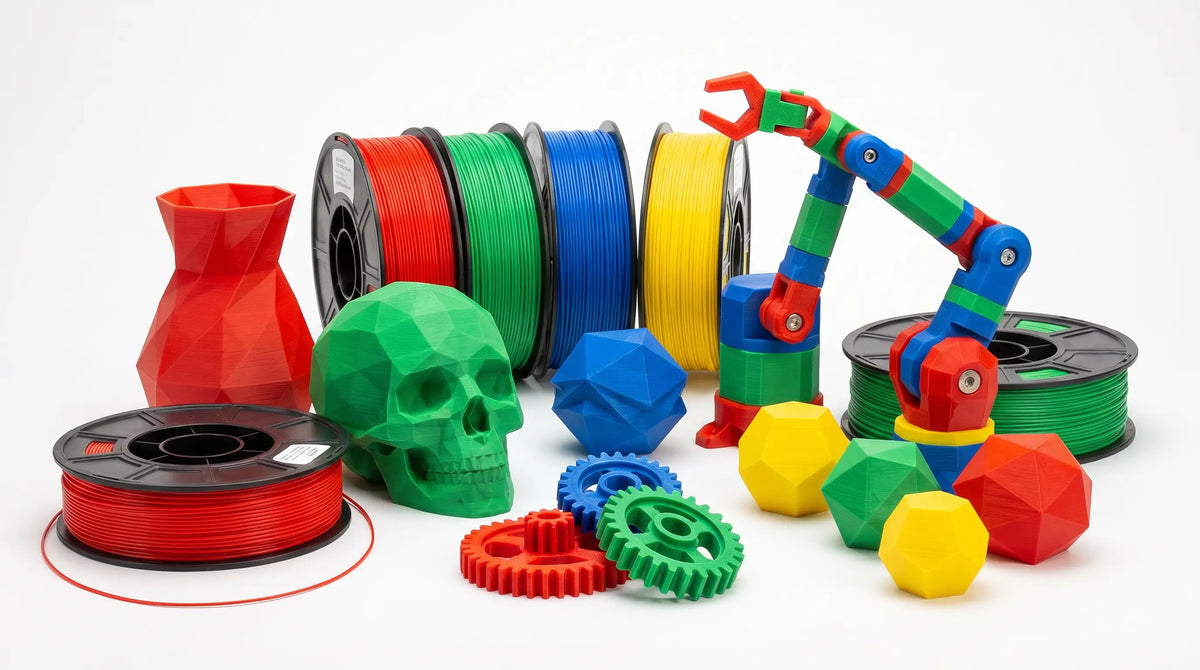
PLA 3D printing — the complete material guide
- PLA is the most print-friendly FDM material — low shrinkage, no heated bed required, minimal odor
- Maximum service temperature around 55-60°C — not suitable for heat-exposed functional parts
- Perfect for prototypes, figurines, indoor displays and early iterations
- PLA-CF and PLA-HF offer increased stiffness and surface quality for more demanding use
- Bio-based and compostable under industrial conditions — not in a household composter
PLA 3D printing is the starting point for the vast majority of 3D printing jobs. The material is bio-based, easy to print and produces sharp detail — but it has limitations in temperature and mechanical strength that you should know before choosing it for your project. This guide gives you the full picture.
What is PLA, and why is it popular?
PLA — polylactic acid — is a bio-based thermoplastic made primarily from corn starch or sugarcane. It's the most widely used FDM filament in the world, and the reason is simple: PLA is the easiest to print of all standard FDM materials. It requires no heated bed beyond light adhesion, has minimal shrinkage, and releases almost no odor while printing.
For a 3D print service like Maker Factory, that means we can print PLA parts quickly and consistently with a minimal failure rate. That gives you shorter lead times and more predictable prices as a customer.
When do you choose PLA?
Prototypes and design validation
PLA is the ideal material for early design iterations. The price is low (DKK 0.20-0.30/g with us), print time is short, and you can have a prototype in hand within 24-48 hours. Detail reproduction is good — PLA captures corners and fine surfaces better than PETG at a standard layer height of 0.15-0.20 mm. Once the design is validated, you can choose a stronger material for the final part.
Indoor decorative purposes and figurines
Figurines, sculptures, indoor displays, architectural models and event decorations — PLA is perfect. The material comes in hundreds of colors, is easy to paint and finish, and holds its shape at normal indoor temperatures (up to 50-55°C). We've printed everything from retail displays to trade show prototypes in PLA with excellent results.
Education and hobby use
Schools, colleges and universities use PLA for STEM projects because it's safe, cheap and easy to handle. Hobbyists use it to print spare parts for toys, home decor and accessories. When the temperature doesn't exceed 55°C and there's no mechanical load, PLA is an excellent choice.
- You need a fast, cheap prototype for design validation
- The part will be used indoors and not exposed to heat above 55°C
- You want sharp detail and good surface quality without post-processing
- The project is for education, hobby use or decoration
- The part sits close to a heat source (motors, sun-exposed surfaces, coffee machines)
- You need chemical resistance (PLA is degraded by alcohol and organic solvents)
- The part is exposed to constant mechanical load over time (PLA is brittle and can break)
- The project is outdoors (UV degrades PLA over months)
PLA variants: standard, CF and HF
Standard PLA is the starting point, but there are specialty variants with enhanced properties:
Standard PLA
Comes in many colors, inexpensive (from DKK 50 per part), easy to finish with sandpaper and paint. Print temperature 190-220°C. Bed temperature: 25-60°C. Suitable for all indoor, non-loaded purposes. Strength: 50-65 MPa in tension.
PLA-CF (carbon-fiber-reinforced)
PLA blended with short carbon fiber particles. The result is significantly higher stiffness (E-modulus increases by around 40%) and a characteristic matte, dark surface. PLA-CF isn't stronger in tension than standard PLA, but the increased stiffness gives better dimensional stability for precision parts. Print temperature 200-230°C. Requires a hardened steel nozzle.
PLA High Flow (HF)
Optimized rheology for fast printing — up to 3x faster than standard PLA. Properties are similar to standard PLA, but surface quality at high speed is better. We use HF for production runs where lead time is critical but maximum detail isn't required.
A Danish design company ordered 8 iterations of the same product bracket over 3 weeks. We printed all 8 in PLA — cheap and fast for design validation. Iteration 8 went into production in PETG-CF. Total design cost: DKK 1,200 including shipping. An equivalent round of CNC prototyping would have cost DKK 15,000-20,000.
PLA vs. PETG and ABS — comparison
The three most commonly used FDM materials are PLA, PETG and ABS. Here's a direct comparison to help you choose:
| Property | PLA | PETG | ABS |
|---|---|---|---|
| Printability | ⭐⭐⭐⭐⭐ Very easy | ⭐⭐⭐⭐ Easy | ⭐⭐⭐ Moderate |
| Max. service temperature | 55-60°C | 75-80°C | 90-100°C |
| Tensile strength | 50-65 MPa | 45-55 MPa | 40-50 MPa |
| Impact toughness | Low (brittle) | High (flexible) | High |
| Chemical resistance | Low | Good | Good |
| UV stability | Low (degrades) | Moderate | Low (yellows) |
| Price (relative) | Low | Moderate | Moderate |
Technical specifications
| Parameter | Standard PLA | PLA-CF |
|---|---|---|
| Print temperature | 190-220°C | 200-230°C |
| Bed temperature | 25-60°C | 45-60°C |
| Tensile strength | 50-65 MPa | 55-70 MPa |
| E-modulus (stiffness) | 3.5-4.0 GPa | 5.0-6.5 GPa |
| HDT (heat stability) | 52-60°C | 55-65°C |
| Density | 1.24 g/cm³ | 1.28 g/cm³ |
| Shrinkage | 0.2-0.3% | 0.1-0.2% |
PLA in batch production — when does it make sense?
PLA isn't only used for single parts. We regularly print runs of 50-500 pieces in PLA for customers with an ongoing need. Typical use cases are seasonal merchandise, trade show displays and campaign materials.
Batch size and price per piece
The per-piece price drops with larger runs, because setup time is spread across more parts and we can optimize printer occupancy. A part that costs DKK 150 as a single item typically costs DKK 80-100 each at 50+ pieces and DKK 60-80 each at 100+ pieces. PLA is well suited to batch production because the printing process is stable and the failure rate is low.
Surface quality on production runs
For visible surfaces on production runs we use a 0.15 mm layer height and careful first-layer calibration. Surface quality is even and reproducible. If you want even smoother surfaces, we offer post-processing (sanding + spray) for a surcharge.
Color choice in PLA production runs
We keep the most popular RAL colors in stock in PLA, including black, white, gray, red, blue and green. Custom colors can be sourced with 5-10 business days of extra lead time. Our filament supplier is primarily Bambu Lab and Polymaker.
PLA post-processing and finishing options
PLA is the most post-processing-friendly 3D print material. Here are the options we offer:
Sanding and painting
We sand PLA parts with 120→220→400 grit and prime with acrylic primer. The result is a surface that doesn't reveal it was 3D printed. Typical surcharge: DKK 150-400 depending on the part's complexity and size.
Epoxy coating
XTC-3D or similar epoxy is applied as a thin layer and chemically smooths layer lines. Good for figurines and display objects. Gives a glossy finish. Surcharge: DKK 100-250.
Painting
After priming, PLA can be painted with acrylic paint, hobby airbrush or RAL spray. For large production runs we use a spray booth. We always recommend a primer base coat — PLA is smooth and paint adheres better to a roughened primed surface.
Read more about our post-processing service including sanding, painting and coating.
Upload your STL file and receive a quote within 24 hours — we'll advise you on the right material.
Request a quote →FAQ — PLA 3D printing
What is the maximum service temperature for PLA?
PLA's Heat Deflection Temperature (HDT) is typically 52-60°C depending on the filament type. That means PLA parts aren't suitable for use near heat sources, in cars during summer, in direct sunlight, or near machines that generate heat.
Is PLA strong enough for functional parts?
PLA has good tensile strength (50-65 MPa) but is brittle — it tends to snap rather than bend. For statically loaded indoor parts PLA is fine, but for dynamic loads, impact or vibration environments, PETG or PA6-CF are better choices. See our material guide.
Can PLA be used for food contact?
PLA is bio-based and generally considered non-toxic in its cured form, but 3D-printed parts have micro-porosity that can harbor bacteria. For direct food contact we recommend food-safe resin (SLA) or an epoxy coating on the PLA part.
Is PLA biodegradable?
PLA is compostable under industrial conditions (high temperature + moisture in commercial facilities) — not in a normal household composter. Under normal ambient conditions, PLA breaks down slowly over years, not months.
What does PLA 3D printing cost at Maker Factory?
We price based on grams of material + print time + setup. A typical prototype part at 50-100g costs DKK 100-250 excl. VAT. We provide a quote within 24 hours — upload your STL file via the quote form.
Can PLA be painted and finished?
Yes. PLA can be sanded, primed and painted with acrylic paints. The surface can also be smoothed with XTC-3D or polyester filler to hide layer lines. We offer professional post-processing including sanding and painting.
Is PLA-CF better than standard PLA?
PLA-CF is stiffer (higher E-modulus) and has a more professional matte finish, but isn't significantly stronger in tension. Choose PLA-CF when dimensional stability matters — for example for precision components or parts visible in a professional product.
Mere fra Blog
 PC 3D printing — polycarbonate for heat and industrial parts
In short — PC (polycarbonate) 3D printing: PC is the strongest and most heat-resistant FDM material for technical parts —...
Læs artiklen →
PC 3D printing — polycarbonate for heat and industrial parts
In short — PC (polycarbonate) 3D printing: PC is the strongest and most heat-resistant FDM material for technical parts —...
Læs artiklen →
 3D printed jigs and fixtures — faster and cheaper than CNC
In short — 3D printed jigs and fixtures: 3D printed jigs and fixtures cost 5–20× less than CNC-machined aluminum and...
Læs artiklen →
3D printed jigs and fixtures — faster and cheaper than CNC
In short — 3D printed jigs and fixtures: 3D printed jigs and fixtures cost 5–20× less than CNC-machined aluminum and...
Læs artiklen →
 Nylon 3D printing — PA6-CF for industry and functional parts
In short — the key facts about nylon 3D printing: Nylon (polyamide) is the strongest FDM material for mechanically loaded...
Læs artiklen →
Nylon 3D printing — PA6-CF for industry and functional parts
In short — the key facts about nylon 3D printing: Nylon (polyamide) is the strongest FDM material for mechanically loaded...
Læs artiklen →