

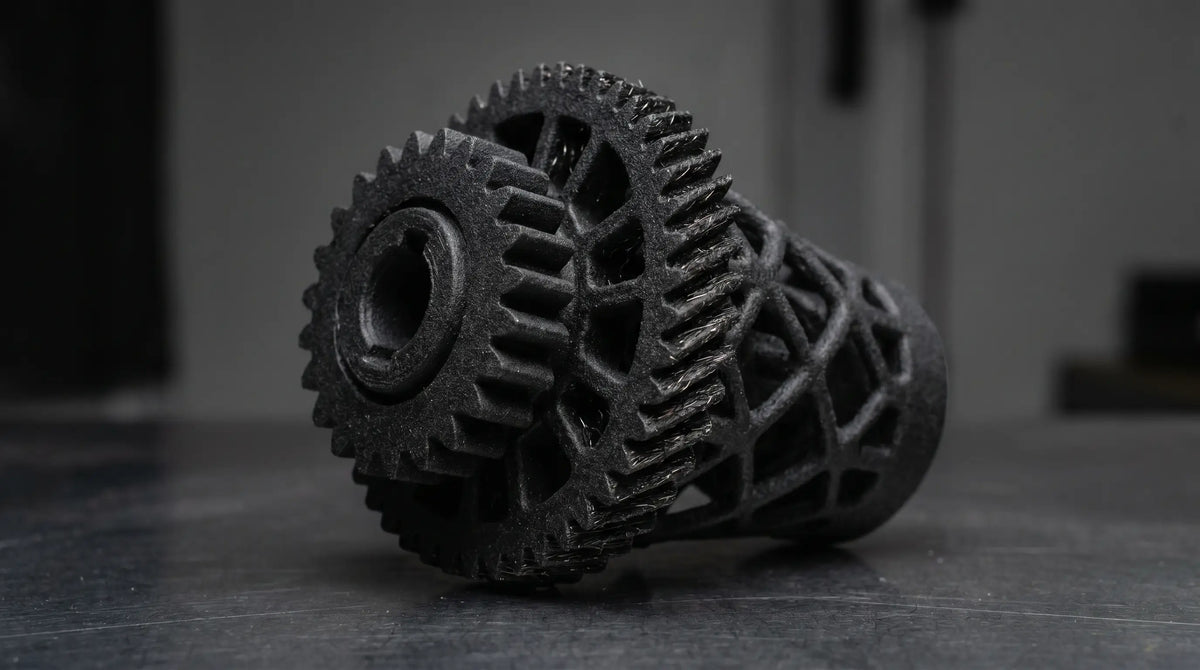
Nylon 3D printing — PA6-CF for industry and functional parts
- Nylon (polyamide) is the strongest FDM material for mechanically loaded functional parts
- PA6-CF (carbon-fiber nylon) gives stiffness + strength for industrial jigs, consoles and mechanical brackets
- Nylon is hygroscopic — filament must be dried before printing to avoid porosity and loss of strength
- Service temperature 120-130°C (PA6-CF) — significantly above PLA and PETG
- We print nylon daily and deliver across Denmark in 3-6 business days
Nylon 3D printing — also called polyamide printing or PA printing — is the preferred choice for mechanically loaded functional parts that need strength, flexibility and temperature resistance far beyond what PLA and PETG can deliver. This guide covers when to choose nylon, which variant to use, and what it costs.
What is nylon 3D printing?
Nylon is an umbrella term for polyamide thermoplastics. In the 3D printing world, the most commonly used variants are PA6, PA6-CF (carbon-fiber-reinforced), PA12 and PA-GF (glass-fiber-reinforced). They all share the basic nylon chemistry: long polyamide chains that give a unique combination of strength, toughness and chemical resistance.
In FDM 3D printing, PA6-CF is the most commonly used nylon material at Maker Factory. It prints at 270-290°C and requires a hardened steel nozzle. The result is a part with significantly better mechanical properties than PLA, PETG and ABS — at a lower price than CNC-machined aluminum.
Nylon is also used in SLS printing (Selective Laser Sintering) as PA12 powder — but that's a different technology requiring industrial machines we don't use. Our nylon printing is FDM-based PA6-CF from Bambu Lab.
When do you choose nylon?
Mechanically loaded functional parts
Do you have a bracket, a clamp, a bearing block or a gear that needs to carry load over time? Nylon holds up. Standard PLA cracks under impact. PETG gradually bends under constant load (creep). Nylon — and especially PA6-CF — retains its geometry and strength under both static and dynamic load. We've printed PA6-CF brackets that are mounted in production machinery and run 8-12 hours a day for months with no visible wear.
High service temperature
Nylon withstands 120-130°C in continuous use. That's essential for parts near motors, in car interiors (which can reach 80-90°C in summer), near electronic components, or in industrial processes with hot air or steam. PLA deforms at 55°C — it won't survive a car in summer sun.
Chemical resistance and moisture
Nylon is resistant to oil, grease and many organic solvents — properties that are critical in industrial and automotive applications. It does, however, absorb moisture from the air (hygroscopic), which can actually be an advantage in applications that need a degree of elasticity, but a disadvantage if you print in high humidity. Our filament is stored in sealed boxes with silica gel.
- The part needs to withstand mechanical load, impact or vibration over time
- The service temperature exceeds 75°C (PETG's limit)
- You need chemical resistance against oil and grease
- You're replacing a CNC-machined aluminum part with a lighter solution
- The service temperature is under 75°C and there's no extreme mechanical load
- Price matters more than optimal mechanical performance
- The part is visible and you want a smooth, attractive surface
- You're printing transparent or light-colored parts (nylon is matte and dark gray)
PA6, PA6-CF and PA12 — variants and differences
The nylon family in FDM 3D printing mainly covers two branches: PA6 and PA12. Here are the differences:
PA6 (standard nylon 6)
PA6 is the most widely used nylon type for FDM. Good strength, moderate chemical resistance, print temperature 240-260°C. Absorbs moisture (around 3.5% at full saturation), which can cause dimensional change in humid environments. Printability is challenging — requires dried filament and good adhesion to the heated bed.
PA6-CF (carbon-fiber nylon)
PA6-CF is PA6 blended with short carbon fiber particles (typically 15-20% by weight). The result is significantly higher stiffness (E-modulus increases 2-3x compared to standard PA6), lower shrinkage and better dimensional stability. Tensile strength increases by around 30-50%. It's our preferred nylon material for industry and delivers the best results for jigs, fixtures and loaded brackets.
PA12 (nylon 12)
PA12 has lower moisture absorption than PA6 (about 0.25% vs. 3.5%) and better chemical resistance. It's the primary material for SLS printing (powder bed) and is used in medical, prosthetics and precision components. In FDM, PA12 filament is available but rarely used — SLS delivers far better properties for PA12. We don't offer PA12 in FDM in our service lineup.
A machine shop asked us to print 8 assembly jigs for a new production line. We printed in PA6-CF — the choice was made because the jigs hold metal parts in place during welding and are exposed to heat up to 100°C from the welding process. Two years and 50,000+ operations later, all 8 jigs are still in use. The CNC alternative would have cost 5x as much and taken 4 weeks to produce.
Nylon vs. PETG, ABS and PC
| Property | PA6-CF | PETG | ABS | PC |
|---|---|---|---|---|
| Tensile strength | 80-110 MPa | 45-55 MPa | 40-50 MPa | 55-75 MPa |
| Max. temp. | 120-130°C | 75-80°C | 90-100°C | 110-130°C |
| Impact toughness | High | High | High | Very high |
| Chemical resistance | Good | Good | Good | Moderate |
| Printability | Challenging | Easy | Moderate | Challenging |
| Relative price | High | Low | Moderate | High |
Technical specifications
| Parameter | PA6-CF (Bambu Lab) | Standard PA6 |
|---|---|---|
| Print temperature | 270-290°C | 240-265°C |
| Bed temperature | 80-90°C | 70-85°C |
| Tensile strength | 80-110 MPa | 50-70 MPa |
| E-modulus | 8-12 GPa | 2-3 GPa |
| HDT (1.8 MPa) | 120-130°C | 65-80°C |
| Moisture absorption | ~2.5% | ~3.5% |
| Density | 1.10-1.15 g/cm³ | 1.13 g/cm³ |
The nylon printing process — what makes it difficult?
Nylon is one of the most demanding FDM materials to print, and that's one of the reasons many choose a professional print service instead of attempting it themselves. Here's what makes nylon challenging:
High moisture absorption — filament needs to be dried
Nylon absorbs moisture from the air within hours. A spool of filament that's been left out for 12-24 hours in a normal room (50-60% relative humidity) can have absorbed enough moisture to significantly affect print quality. Wet nylon causes bubbles in the melt stream, a porous surface and poor layer adhesion — which reduces the part's strength by 20-40%. We always use dried filament and a sealed spool holder during printing.
Shrinkage and warping
Nylon shrinks 1-2% on cooling — significantly more than PLA (0.2%) and PETG (0.4%). That means large flat parts can lift off the print bed (warping), or dimensions may not hold tolerance without proper calibration. We use a heated bed (85°C), an enclosed chamber and adhesion plates specifically for nylon to minimize warping.
Hardware requirements
Nylon and PA6-CF require: a hardened steel nozzle (the carbon fiber wears down brass nozzles very quickly), a print temperature of 270-290°C (above a standard brass hotend's maximum), a heated bed, and preferably an enclosed chamber. Our Bambu Lab X1C machines are configured specifically for engineering materials like PA6-CF.
Surface quality and finish
PA6-CF is matte and dark — typically anthracite gray. The surface is rougher than PLA and PETG at the same layer height, because the carbon fiber particles protrude slightly. For parts where appearance is secondary to function, this is irrelevant. For visible parts, the surface can be improved with sanding and coating. See our post-processing guide.
Need nylon 3D printing for industrial use? Upload your STL file and receive a quote within 24 hours.
Request a quote →FAQ — Nylon 3D printing
What's the difference between PA6 and PA12 in 3D printing?
PA6 is the most widely used FDM nylon, with good mechanical strength but higher moisture absorption (about 3.5%). PA12 is primarily an SLS material with lower moisture absorption (0.25%) and is preferred for medical and precision equipment. In our FDM service, we primarily use PA6-CF.
Is nylon 3D printing expensive?
Nylon is more expensive than PLA and PETG due to material cost and a challenging printing process, but still significantly cheaper than CNC-machined metal for the same function. A typical PA6-CF jig at 200-300g costs DKK 400-800 excl. VAT. A CNC alternative in aluminum typically costs DKK 3,000-8,000.
Can nylon 3D printed parts be used outdoors?
Yes. Nylon has far better UV stability than PLA and moderately better than PETG. For aggressive outdoor environments (prolonged sun exposure, salt air, chemicals) we recommend ASA over nylon — ASA is specifically formulated for outdoor durability. Read our ASA guide.
Does nylon filament need to be dried before printing?
Yes — it's critical. Nylon absorbs moisture from the air (hygroscopic), and wet filament causes bubbles, porosity and poor layer bonding that reduces strength by 20-40%. We always dry our PA6-CF filament at 80°C for 6-8 hours before printing and use sealed filament boxes during the printing process.
What are the typical applications for nylon 3D printing?
Mechanical brackets and clamps, assembly jigs for production, gears and bearings for light loads, cable glands and enclosures for industry, automotive components and spare parts, and any part that requires an operating temperature above 80°C.
Do you print PA6-CF and can you deliver across Denmark?
Yes to both. PA6-CF is our primary engineering material for industrial use. We deliver with PostNord across Denmark, including Aarhus, Odense and Copenhagen. Lead time: typically 4-7 business days for PA6-CF orders.
What are the alternatives to nylon if I need something even stronger?
For extreme strength in FDM, PC (polycarbonate) and PC-CF offer higher impact toughness than nylon. For ultimate strength and lowest weight, continuous carbon fiber composite is an option, but it requires specialized machines we don't currently have. Contact us for advice on the right material.
Henrik Beck, Owner — Maker Factory
3D print service since 2013 · CVR 38935836 · Denmark
We print PA6-CF for industrial customers across Denmark. The material is our recommended choice for all mechanically loaded and temperature-exposed functional parts. Read more about our materials: PA6-CF material page, complete material guide and PETG-CF.
Mere fra Blog
 PC 3D printing — polycarbonate for heat and industrial parts
In short — PC (polycarbonate) 3D printing: PC is the strongest and most heat-resistant FDM material for technical parts —...
Læs artiklen →
PC 3D printing — polycarbonate for heat and industrial parts
In short — PC (polycarbonate) 3D printing: PC is the strongest and most heat-resistant FDM material for technical parts —...
Læs artiklen →
 3D printed jigs and fixtures — faster and cheaper than CNC
In short — 3D printed jigs and fixtures: 3D printed jigs and fixtures cost 5–20× less than CNC-machined aluminum and...
Læs artiklen →
3D printed jigs and fixtures — faster and cheaper than CNC
In short — 3D printed jigs and fixtures: 3D printed jigs and fixtures cost 5–20× less than CNC-machined aluminum and...
Læs artiklen →
 PLA 3D printing — the complete material guide
In short — the key facts about PLA 3D printing: PLA is the most print-friendly FDM material — low shrinkage,...
Læs artiklen →
PLA 3D printing — the complete material guide
In short — the key facts about PLA 3D printing: PLA is the most print-friendly FDM material — low shrinkage,...
Læs artiklen →