

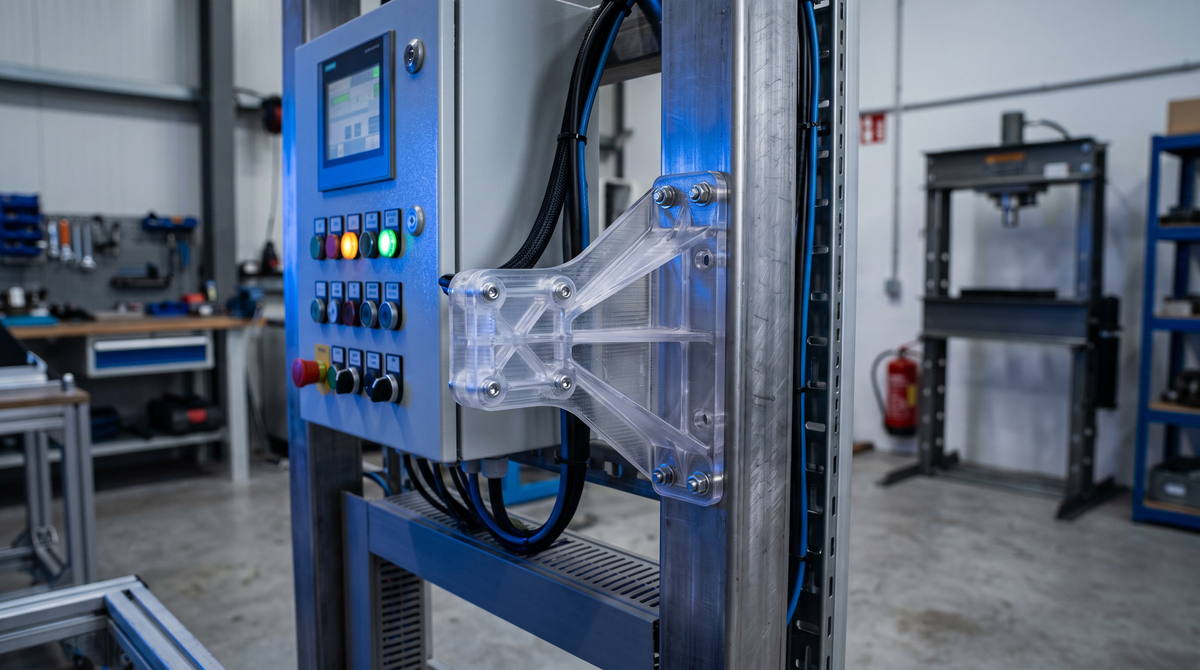
PC 3D printing — polycarbonate for heat and industrial parts
- PC is the strongest and most heat-resistant FDM material for technical parts — glass transition temperature up to 150°C
- Used for heat-exposed parts, safety components and industrial housing and enclosure parts
- Requires high print temperatures (260-300°C), an enclosed chamber and thorough filament drying — we handle that for you
- No minimum order — we print from 1 prototype to batch production with delivery in 2-5 business days across Denmark
- Upload your STL and receive a quote within 24 hours via the quote request form
What is PC (polycarbonate) material?
PC material — polycarbonate — is a thermoplastic material with extraordinary impact resistance and high heat resistance. When you 3D print in PC, you get parts that hold up even when exposed to mechanical load, high temperatures and repeated use. That's why PC 3D printing is used for technical and industrial applications where PLA and PETG aren't sufficient.
Polycarbonate is used in industry for everything from safety glasses and car panels to electronics covers and machine parts — and you can now get that same strength via 3D printing at a fraction of the cost of traditional tooling. PC is recognized as the strongest widely available FDM filament and the choice when temperature and strength requirements are high.
We regularly print in PC and PC-FR (flame-retardant variant) for customers in industry, electronics and machine manufacturing. The material requires precise temperature control and an enclosed printer — something we have the technology and experience to handle correctly.
PC material is in the same family as the polycarbonate used in safety glasses, DVDs and car windows. It's extensively tested and documented industrially — and its properties largely carry over to 3D-printed parts too, provided the print process and material choice are correct. According to the MatWeb material database, PC has an impact resistance 20-40 times higher than glass at comparable stiffness — and that's the property that makes it unique in a 3D printing context.
We recommend PC when the customer needs a material that combines stiffness and impact resistance better than ABS — and that withstands temperatures PETG can't handle. For the most extreme temperature requirements (above 150°C), PA6-CF and specialty materials like PEEK are better choices. See our material overview to compare all the FDM materials we print in.
When do you choose PC over other materials?
When the part needs to withstand high temperatures
PC has a glass transition temperature of 110-150°C, depending on type. That makes the material the obvious choice for parts near heat sources — for example engine compartments, industrial ovens, tumble dryers and electronics covers. ABS tops out at 98°C and PLA already at 60°C. If your part risks deforming in a hot environment, PC is the right choice.
When impact resistance and stiffness are critical
Polycarbonate combines high stiffness with good impact resistance — a combination that's rare. Many strong materials are brittle (e.g. PA6-CF), and many impact-resistant materials are soft (e.g. TPU). PC hits the middle ground: it doesn't flex unnecessarily, but it doesn't crack on impact either. That makes it ideal for assembly parts, brackets and components that are mounted and removed repeatedly.
For safety-relevant and protective components
PC is used in industrial settings for safety-relevant parts — shields, protective covers, locking mechanisms and enclosures for critical electronics. The material's optical clarity in its clear variant also makes it well suited to transparent covers and indicator windows that require higher temperature resistance than acrylic.
- The part needs to remain stable above 100°C (e.g. near heat sources, inside machines)
- You need an impact-resistant, stiff construction that withstands repeated assembly/disassembly
- Electronics or safety covers need to meet flame-retardant requirements (choose PC-FR for that)
- The alternative to PC is metal — and you want to reduce weight and production time
PC vs. ABS, PA6-CF and PETG — comparison
| Material | Strength | Heat (Tg) | Impact resistance | Difficulty | Typical use |
|---|---|---|---|---|---|
| PC | ★★★★★ | 110-150°C | ★★★★☆ | High | Technical industrial parts, covers |
| ABS | ★★★☆☆ | 95-100°C | ★★★☆☆ | Medium | Consumer goods, housings |
| PA6-CF | ★★★★★ | 180-200°C | ★★★☆☆ | High | Jigs, fixtures, structural parts |
| PETG | ★★★☆☆ | 75-80°C | ★★★★☆ | Low | Versatile, mechanical parts |
| PLA | ★★☆☆☆ | 55-60°C | ★★☆☆☆ | Very low | Prototypes, models |
Technical specifications for PC 3D printing
| Parameter | Standard value | Note |
|---|---|---|
| Print temperature | 260-300°C | Requires a high-temp hotend |
| Build plate temp. | 80-120°C | PEI surface recommended |
| Glass transition (Tg) | 110-150°C | Depends on blend |
| Stiffness (Young's modulus) | ~2.3 GPa | Comparable to ABS |
| Tensile strength | 55-70 MPa | Higher than ABS and PETG |
| Impact resistance (Charpy) | ~80 kJ/m² | Significantly above ABS |
| Moisture sensitivity | High | Dried at 80°C for 4-6 h before printing |
| Shrinkage | 0.5-0.7% | Enclosed chamber required |
| Available variants | PC, PC-FR, PC-CF | FR = flame-retardant, CF = carbon-fiber-reinforced |
From experience: PC for industrial parts
A machine manufacturer contacted us needing a replacement cover for an older control panel. The original part was discontinued by the manufacturer, and tooling would have cost DKK 80,000. We printed in PC-FR — flame-retardant polycarbonate — and delivered 5 covers within 3 business days at a tenth of the tooling cost. The parts remain stable at 120°C and meet the UL 94 V-0 flammability rating.
PC is the obvious choice when customer-specific spare parts can't be sourced through normal channels. We have experience matching mechanical requirements to material properties and can advise on when PC makes sense — and when PA6-CF or ABS is a better match.
For customers with fire safety requirements, we generally recommend PC-FR (polycarbonate with flame retardant), which is UL 94 V-0 certified and well suited to electrical enclosure parts and control panels.
What does PC 3D printing cost?
PC printing is more expensive than PETG and PLA but cheaper than metal and injection molding. The price depends on print volume (grams), print time and complexity. As a rule of thumb: a small technical part at 50-100 grams typically costs DKK 250-600 including setup and delivery.
For batch production, the price naturally scales down per unit. We always give a fixed price in the quote — no surprises. Quotes are sent within 24 hours of uploading your file via our quote request page.
See more about pricing and calculation in our guide: What does 3D printing cost?
Upload your STL file and receive a quote for PC 3D printing within 24 hours.
Request a quote →FAQ about PC 3D printing
What is PC 3D printing used for?
PC 3D printing is primarily used for technical and industrial applications where high heat resistance and impact resistance are needed. Typical examples: electronics covers, machine parts, safety components, spare parts for heat-exposed environments, and prototypes for CE approval.
What's the difference between PC and PC-FR?
PC is standard polycarbonate. PC-FR (flame retardant) is a variant with additives that slow combustion. PC-FR is UL 94 V-0 certified and used when electrical enclosure parts, control panels, or safety requirements call for flame-retardant properties. See our PC-FR page.
Can you print PC at home?
Technically possible, but demanding. PC requires print temperatures of 260-300°C, a heated chamber, a high build plate temperature and thorough filament drying. Without the right equipment you risk warping, poor layer adhesion and weak parts. We recommend ordering from an experienced service bureau like Maker Factory rather than attempting it with standard hardware.
What's the lead time on PC printing?
Typically 2-5 business days from order to delivery across Denmark. Complex parts with long print times can take up to 7 business days. We deliver nationwide.
Is PC printing strong enough to replace metal?
In many cases: yes. PC has a tensile strength of 55-70 MPa and withstands repeated mechanical load. For structural applications with high load requirements, we instead recommend PA6-CF (carbon-fiber-reinforced nylon), which is even stronger. PC is best when heat resistance combined with reasonable strength is the deciding requirement.
What does polycarbonate 3D printing cost?
A typical technical part at 50-100 grams costs DKK 250-600 including setup and delivery. The price depends on print volume and complexity. Upload your file to get a precise quote within 24 hours.
What's the difference between PC and PC-CF (carbon fiber)?
PC-CF is polycarbonate reinforced with short carbon fiber particles. It gives significantly higher stiffness but reduces impact resistance slightly compared to pure PC. PC-CF is used for parts primarily exposed to static load that need minimal deformation — for example assembly parts and precision holders. Pure PC is better when impact resistance and repeated mechanical load are the focus. Bambu Lab's PC filament is one of the most widely used in professional settings.
Can PC 3D printing be delivered to businesses?
Yes. We deliver to business customers across Denmark with invoicing and net 8-day payment terms. Batch orders are priced with a per-unit discount. Contact us for a complete solution.
Mere fra Blog
 3D printed jigs and fixtures — faster and cheaper than CNC
In short — 3D printed jigs and fixtures: 3D printed jigs and fixtures cost 5–20× less than CNC-machined aluminum and...
Læs artiklen →
3D printed jigs and fixtures — faster and cheaper than CNC
In short — 3D printed jigs and fixtures: 3D printed jigs and fixtures cost 5–20× less than CNC-machined aluminum and...
Læs artiklen →
 Nylon 3D printing — PA6-CF for industry and functional parts
In short — the key facts about nylon 3D printing: Nylon (polyamide) is the strongest FDM material for mechanically loaded...
Læs artiklen →
Nylon 3D printing — PA6-CF for industry and functional parts
In short — the key facts about nylon 3D printing: Nylon (polyamide) is the strongest FDM material for mechanically loaded...
Læs artiklen →
 PLA 3D printing — the complete material guide
In short — the key facts about PLA 3D printing: PLA is the most print-friendly FDM material — low shrinkage,...
Læs artiklen →
PLA 3D printing — the complete material guide
In short — the key facts about PLA 3D printing: PLA is the most print-friendly FDM material — low shrinkage,...
Læs artiklen →