

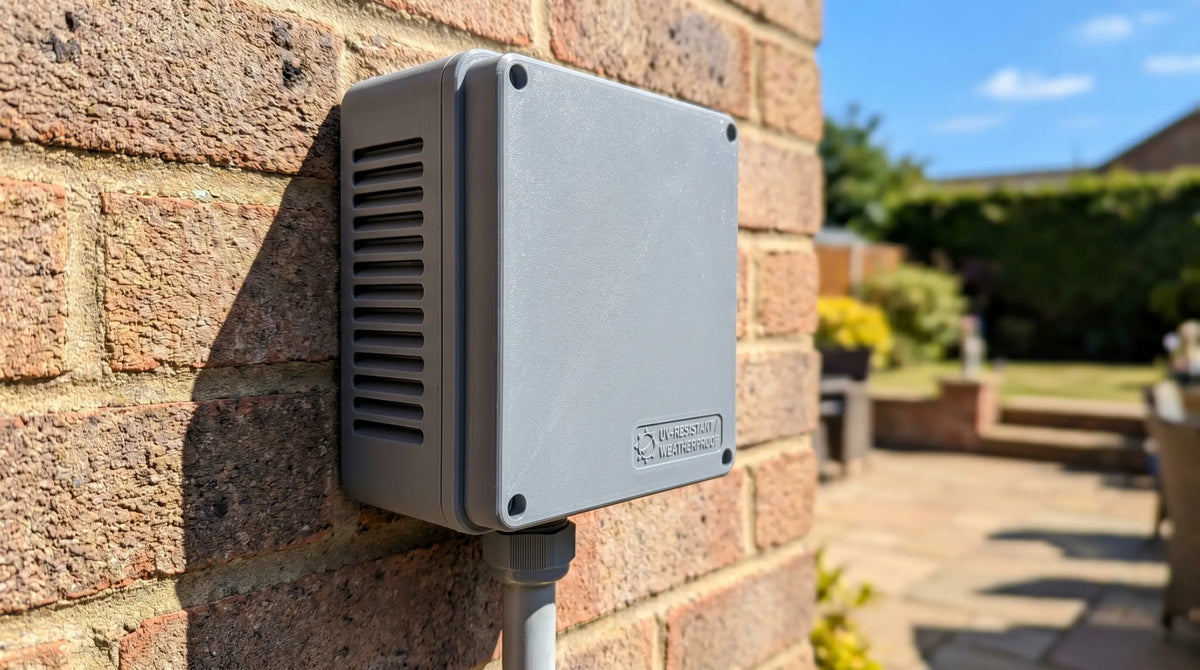
ASA 3D printing — UV-stable plastic for outdoor and industrial use
- ASA is the best FDM material for outdoor and UV-exposed applications — keeps its color and strength for years
- Withstands continuous use up to 95–100 °C — better than PETG (80 °C) and PLA (60 °C)
- Used in the automotive industry for radiator grilles and side mirrors because of its weather resistance
- We print it on the Bambu Lab H2D with a heated chamber — necessary for stable ASA printing
- An alternative to ABS with better UV stability and easier printability
Table of contents:
What is ASA? · When should you choose ASA? · ASA vs. PETG and ABS · Typical jobs · What does it cost? · FAQ
ASA 3D printing is the answer when parts need to live outdoors. While PLA turns brittle and PETG discolors and loses strength in UV light, ASA is specifically formulated to withstand sun, rain, temperature swings, and mechanical load over the long term. At Maker Factory, we use ASA for everything from facade signage and outdoor camera brackets to marine components and agricultural sensors.
What is ASA?
ASA is a thermoplastic in the styrenic family, modified with acrylate rubber to deliver outstanding UV stability. Chemically, it's closely related to ABS, but the acrylate component replaces the butadiene rubber, giving far better weather resistance. The material has a matte surface finish and is printed with a heated build plate and an enclosed printer chamber to prevent warping.
When should you choose ASA 3D printing?
ASA is the right choice when long-term durability under UV light and weather exposure is essential:
- Outdoor camera brackets, sensor mounts, and antenna holders
- Facade signage, information boards, and street furniture components
- Marine applications: boat components, fishing equipment, harbor fittings
- Agricultural equipment: sensors, valves, and housings for fields and barns
- Automotive exterior: trim, mirror brackets, roof box components
UV stability — the key argument for ASA
Most plastics degrade quickly in sunlight. PLA starts to fade and become brittle after 3–6 months outdoors. ABS holds up better, but discoloration becomes visible after a year. ASA is in a different class: formulated to withstand 10+ years in a UV-exposed environment without significant color change or loss of strength. The same property is used in the automotive industry for radiator grilles, side mirrors, and other UV-exposed exterior components.
Temperature tolerance for hot environments
ASA withstands continuous use at 95–100 °C — significantly better than PETG (75–80 °C) and PLA (55–60 °C). That makes ASA relevant for parts located near heat sources: engine bay accessories, cooling fins, and thermal management housings. Combined with its UV stability, ASA is the natural choice for parts that sit outdoors and are exposed to solar heat.
Mechanical strength for outdoor use in freezing weather
ASA matches ABS's mechanical properties in tensile strength and stiffness — and exceeds it in impact strength at low temperatures. That's relevant for outdoor applications in the Danish climate, where temperatures can drop below -10 °C in winter. Parts that need to stay intact and function in freezing conditions are a clear ASA domain.
- The part will sit outdoors in direct sun for more than 3 months
- You need temperature resistance above 80 °C
- Marine or agricultural environments with moisture and salt water
A customer in the agricultural sector ordered 40 sensor housings for moisture meters in fields. The first batch was in PETG — after 3 months in the field, half of them were brittle and discolored. We produced the next batch in ASA. Two seasons later, they're still intact. Investing in the right material pays off.
ASA vs. PETG and ABS
| Property | ASA | PETG | ABS |
|---|---|---|---|
| UV stability | ★★★★★ | ★★☆☆☆ | ★★★☆☆ |
| Max. temp. | 95–100 °C | 75–80 °C | 90–95 °C |
| Printability | Good | Very good | Difficult |
| Weather resistance | Excellent | Moderate | Moderate |
Typical ASA jobs we handle
- Industrial outdoor mounting: sensors, camera mounts, antenna holders
- Marine and maritime components: valve brackets, cable trays, instrument panels
- Agricultural IoT: housings for weather stations and field moisture meters
- Advertising and events: outdoor signage, displays, and branding elements
What does ASA printing cost?
ASA is priced in line with PETG. A typical sensor housing (80–120g): DKK 350–600 excl. VAT, 2–4 business days. Volume discount from 10+ units.
Have an outdoor application that needs UV-stable plastic? Upload your STL and get a quote within 24 hours.
Request a quote →ASA in practice — what we see from our customers
ASA isn't a material most people order without a good reason. Customers who specifically ask for ASA have typically already tried PLA or PETG — and found that they didn't hold up outdoors. That realization costs time and money, and we see it often: a part that worked perfectly on delivery but started discoloring and becoming brittle after a single summer in the sun.
That's exactly the situation ASA is designed to prevent. We regularly print ASA for customers in agriculture and construction — sensor mounts on combine harvesters, cable clamps for outdoor electrical cabinets, display frames for weather-exposed kiosks. What they all have in common is that the material sits outdoors for years and needs to keep its shape and color.
A concrete example: an agricultural machinery manufacturer ordered 80 ASA enclosures for a GPS antenna mount located on the machine roof. The temperature on top of a metal cabin in direct sunlight can reach 70–80 °C in summer. PETG would have softened. ASA got through the first season with no visible change.
ASA requires an enclosed printer with a heated chamber to print reliably — it's not a material for open hobby printers. We use the fully enclosed Bambu Lab X1-Carbon, which eliminates the main printing challenge with ASA: warping and layer delamination. The result is stable, dense prints with good isotropic strength.
For semi-outdoor use — carports, open-sided sheds, industrial buildings with open doors — ASA is also the right solution. Occasional UV exposure is enough to break down PLA and PETG within 12–18 months. ASA is designed to withstand it. And for DKK 10–30 more per print, it's never a hard decision.
Surface finishing is optional with ASA. The material has a fine, matte finish straight off the printer. Want a smoother surface? We can sand and prime before delivery. ASA takes paint well — polyurethane clearcoat or plastic primers adhere excellently. See our post-processing page for options.
FAQ — ASA 3D printing
Can ASA replace ABS in every application?
In most cases, yes — ASA outperforms ABS on weather resistance and UV stability, matches it on temperature and strength, and is easier to print reliably.
Is ASA available in colors?
We primarily print ASA in black and white. Other colors are possible on request, but UV stability can vary with the colorant used.
What's the difference between ASA and PA6-CF for outdoor use?
PA6-CF is stronger and stiffer than ASA, but absorbs moisture. For marine and wet environments, ASA is actually the better choice. For heavy mechanical loads outdoors, PA6-CF is superior.
Do you print ASA in an enclosed chamber?
Yes — ASA requires a heated build plate (100–110 °C) and an enclosed chamber to avoid warping. Our Bambu Lab H2D is equipped for this.
Can ASA parts be glued and finished?
ASA can be bonded with cyanoacrylate and acetone-based adhesives. The surface can be sanded and painted. Contact us for finishing options.
We printed 60 ASA enclosures for a customer-designed air quality sensor mounted on streetlights in a Danish city. Requirements: UV-resistant, IP54 sealing via gasket tape, and true white color retention for at least 5 years. ASA is the only FDM material that realistically meets all three. Lead time: 8 business days for the whole batch. Price per enclosure: DKK 87 excl. VAT. The customer had used 3 previous suppliers and found ASA was the only material that kept its shape and color after a full season.
We print ASA exclusively on enclosed machines with a heated chamber. It's not a material you can just run through an open printer — it requires stable temperature during printing to avoid delamination and warping. We have that setup in place, and it shows in consistent quality from the first to the last part in a batch.
For larger batches (10+ units), we always offer a volume discount. Send a request with your total quantity, and we'll calculate a combined price. Typical discount at 10–50 units: 10–15%. At 50+ units: 15–25% depending on geometry.
ASA is also one of the few FDM materials that can be coated directly with polyurethane clearcoat or 2-component paint without a primer. That's relevant for parts that need to match an existing product visually — enclosure covers, signage, outdoor display frames. We offer painting as an add-on — mention in your request if this is relevant to your order. See our painting and airbrushing service for options and pricing.
What does ASA cost compared to PETG and ABS? ASA is typically 10–20% more expensive than PETG and 5–15% more expensive than ABS per gram. For a standard 100–200 g print, the price difference is DKK 30–80 — and compared to what it costs to reprint a part after one season in sun and rain, it's always the right investment. We consistently recommend ASA for outdoor applications and would rather explain the price difference than print something in PETG that disappoints the customer 8 months later. Contact us via the request form — we advise on material choice free of charge.
Mere fra Blog
 PC 3D printing — polycarbonate for heat and industrial parts
In short — PC (polycarbonate) 3D printing: PC is the strongest and most heat-resistant FDM material for technical parts —...
Læs artiklen →
PC 3D printing — polycarbonate for heat and industrial parts
In short — PC (polycarbonate) 3D printing: PC is the strongest and most heat-resistant FDM material for technical parts —...
Læs artiklen →
 3D printed jigs and fixtures — faster and cheaper than CNC
In short — 3D printed jigs and fixtures: 3D printed jigs and fixtures cost 5–20× less than CNC-machined aluminum and...
Læs artiklen →
3D printed jigs and fixtures — faster and cheaper than CNC
In short — 3D printed jigs and fixtures: 3D printed jigs and fixtures cost 5–20× less than CNC-machined aluminum and...
Læs artiklen →
 Nylon 3D printing — PA6-CF for industry and functional parts
In short — the key facts about nylon 3D printing: Nylon (polyamide) is the strongest FDM material for mechanically loaded...
Læs artiklen →
Nylon 3D printing — PA6-CF for industry and functional parts
In short — the key facts about nylon 3D printing: Nylon (polyamide) is the strongest FDM material for mechanically loaded...
Læs artiklen →