

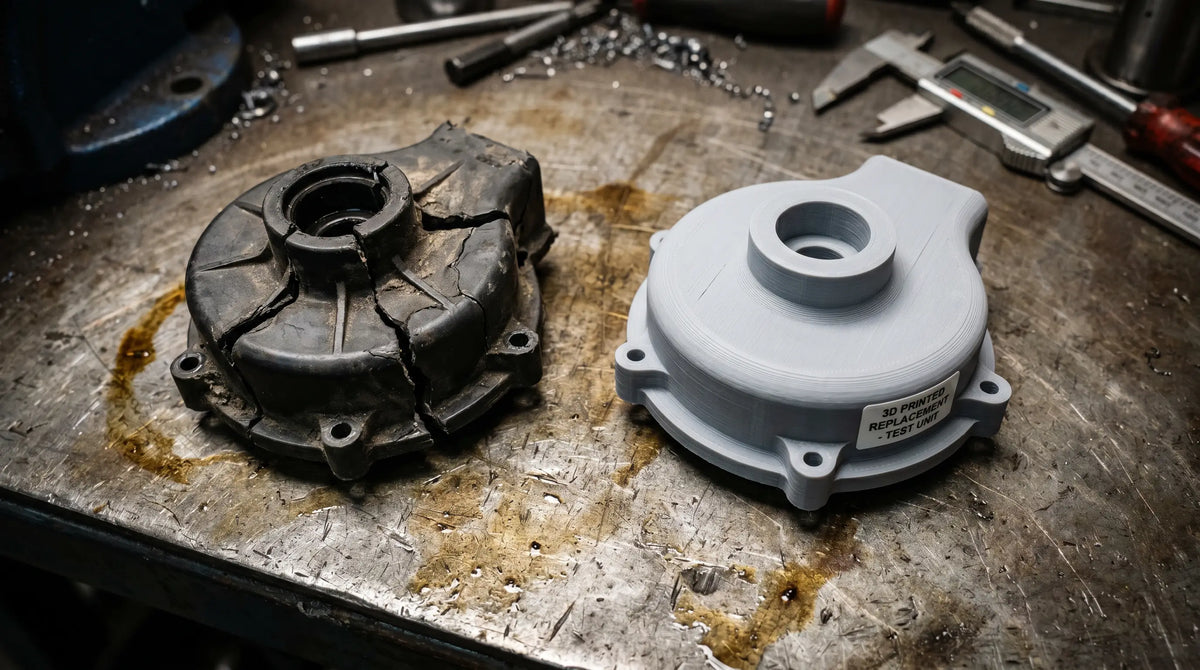
3D printed spare parts for industry — from machine stoppage to delivery in 3 days
- 3D printing is now the fastest route to spare parts when supplier lead time is too long or the part is discontinued
- Materials such as PA6-CF, ASA, and PETG match or exceed the requirements for many plastic parts in industrial equipment
- We can produce from a single spare part — no minimum order, no tooling cost
- From received STL to delivered part: typically 2–4 business days — whether it's 1 or 100 units
- We work under NDA and can handle technical drawings and reverse engineering of existing parts
Table of contents:
When does it make sense? · Materials for spare parts · The process · Typical examples · Limitations · FAQ
A critical machine in your production line is down. The spare part has been discontinued by the manufacturer. Lead time from an alternative supplier is 6–8 weeks. What do you do?
For a growing number of industrial and manufacturing companies, the answer is: 3D print the missing part. The technology — and the materials — have reached the point where this is a real solution, not just a stopgap. At Maker Factory, we print spare parts in technical plastics for machines, production lines, and technical equipment. Here's everything you need to know.
When do 3D printed spare parts make sense?
3D printing isn't the answer to everything — but it's a perfect fit for a number of classic spare-parts scenarios:
- The part is discontinued or has a 6+ week lead time from the original supplier
- You need 1–50 units and molds aren't cost-effective
- The part is plastic or polymer and won't be exposed to temperatures above 150 °C
- You have an STL file, a technical drawing, or can send the original part for scanning/remodeling
Machine downtime — the most expensive kind
Production downtime typically costs thousands of kroner per hour. If a discontinued plastic part is the cause — a cover, a guide, a holder, a bracket — a DKK 500–2,000 3D print is an obvious investment compared to days or weeks of standstill. We've delivered parts for exactly this scenario to manufacturing companies across the country.
Older machines and phased-out products
Machines from the 1980s and '90s are still in use in many factories. Spare parts are either discontinued or only available used. 3D printing makes it possible to produce these parts on demand, based on the original part (reverse engineering + scanning) or existing drawings.
Prototype parts for testing before production
Before ordering 500 molded parts, it's standard practice to print 5–10 units in the actual material for function testing. We print test batches in materials that match your production requirements.
Materials for industrial spare parts
| Material | Max. temp. | Tensile strength | Typical use |
|---|---|---|---|
| PA6-CF | 120 °C | ~90 MPa | Machine parts, jigs, holders |
| ASA | 100 °C | ~55 MPa | UV exposure, outdoor parts |
| PETG | 80 °C | ~50 MPa | Housings, cables, brackets |
| TPU 95A | 80 °C | Flexible | Gaskets, dampers, rails |
| PC (polycarbonate) | 130 °C | ~55 MPa | Transparent parts, high impact strength |
Have specific material requirements (FDA-approved, ESD-safe, flame-retardant)? Contact us — we also print in specialty materials such as PC-FR and can tell you what's possible.
A manufacturing company had machine downtime due to a discontinued plastic guide in an assembly line. The original part was no longer produced. We received the original part by courier, remodeled it in 3D, and printed 3 replacement parts in PA6-CF. From received part to delivered spare parts: 3 business days. The machine's downtime: eliminated.
The process from your problem to a delivered spare part
- You contact us — with an STL file, a drawing, or the original part. Describe material requirements and use.
- We assess and recommend — material, method (FDM/SLA), and what tolerance and quality we can promise
- You receive a quote within 24 hours — with price and lead time
- Production and delivery — typically 2–4 business days. For urgent cases: contact us about express options
Need reverse engineering (we model the part from the original)? We offer this for a surcharge — contact us with photos and measurements of the original part.
Typical spare parts we print
- Guide rails and tracks for conveyor belts
- Combs and holders for automation equipment
- Cable duct brackets and cable guides for machines
- Cover end pieces and protective parts
- Jigs and fixtures for assembly lines
- Gaskets and seals in TPU (as an alternative to rubber)
- Knobs, handles, and panel elements
Read more about our industrial 3D printing service and 3D printing for production →
What 3D printing can't replace
To set the right expectations: plastic 3D printing isn't suited to every spare-parts scenario. It doesn't work well for:
- Metal parts subjected to high load or temperatures above 150 °C
- Parts with tolerance requirements under ±0.05 mm (require CNC machining)
- Parts in rubber or silicone (we can substitute with TPU in certain cases)
- Parts with electrical conductivity requirements (unless an ESD material is specified)
Not sure whether 3D printing is the right solution for your spare part? Contact us — we'll give you an honest assessment.
Machine down? Part discontinued? Contact us — we'll assess whether 3D printing can help, and deliver within days.
Request a quote →Industrial spare parts in 3D printing — what we typically solve
Spare parts for machines that are no longer produced is one of the scenarios that most often surprises customers with how simple the solution is. The classic situation: a production machine from 2004 stops working because a plastic bracket has broken. The supplier no longer exists. The original part number gets zero hits. The alternative is either scrapping the machine or waiting months for a used part.
With 3D printing, the solution instead is: send us the broken part (or a photo plus measurements), and we reverse-engineer the geometry and print a replacement in PA6-CF or PETG. Lead time: 3–5 business days from when we have the measurements/file. Price: typically DKK 200–600 for simple plastic parts. Compared to the alternatives, it's an easy decision.
We regularly handle spare parts for packaging equipment (guide brackets, cable clamps, vacuum cup holders), conveyor belts (guide forks, tensioning brackets, guide rail inserts), agricultural machinery (sensor holders, cable glands, display mounts), and lab equipment (valve holders, hose clamps, test tube holders).
An important caveat: 3D printing isn't a universal answer for every spare part. Parts subject to high impact load, metal-wear contact, or temperatures above 150 °C are typically better solved with CNC machining or metal casting. We say so clearly in the quote, and we always recommend the right material over the cheapest one. It's better to turn down an order than to print something that only lasts three months and lose the customer's trust.
For machine-critical parts, we recommend PA6-CF — carbon fiber-reinforced nylon that's strong, dimensionally stable, and heat-resistant up to 150 °C. It's the material we choose for structural brackets, drive shaft guides, and mounting plates that carry mechanical load. For non-structural parts (covers, lids, cable management), PETG is sufficient and cheaper.
FAQ — 3D printed spare parts
Can you produce parts identical to the original?
Dimensionally, yes — within 3D printing's normal tolerances (±0.2–0.3 mm). The material properties aren't necessarily identical to the original, but we match them as closely as possible. In many cases, 3D printed PA6-CF parts are actually stronger than the original plastic parts.
What if I only have the physical part — no file?
Send us the original part by courier. We'll remodel it (reverse engineering) and create an STL file. The price depends on complexity — contact us with photos for an assessment quote.
Can you handle urgent cases?
Yes — for urgent cases, we have an express option. Contact us directly (email or phone) and we'll assess what we can do. Express production is available for a surcharge.
Do you provide certification or material documentation?
We can issue a material datasheet for the materials we print with. We don't offer full ISO certification, but for most industrial scenarios, the material datasheet is sufficient.
What's the minimum order?
No minimum order — we print from a single part. That's exactly one of the advantages of 3D printing over injection molding.
An important detail for customers sending physical parts for reverse engineering: we always return the original part intact along with the printed replacement. It's rarely necessary to destroy the original part to scan or measure it — with calipers and photo documentation, most simple geometries can be reconstructed without destructive analysis. Complex organic geometries may require 3D scanning, which we can arrange through partners.
For critical machine components, we offer a test print: we print one part for verification, you install and test it, and once approved, we print the full batch. It costs a little more per part, but it eliminates the risk of printing 20 units of a part that doesn't fit. We always recommend a test print for the first run of a new design.
Have a discontinued machine part that needs replacing? Send us a photo or a drawing — we'll assess the job for free and send a quote within 24 hours. We work with customers across Denmark and regularly handle spare-parts jobs for manufacturing companies, agriculture, laboratories, and specialized equipment. Use our request form to start the conversation.
3D printed spare parts aren't just for large companies with production lines. We also solve spare parts for private customers: coffee machines, vacuum cleaners, e-bikes, garden tools. Has a part broken and you can't find a replacement in stores? Send us a photo and measurements — we'll assess whether 3D printing is a suitable solution and provide a quote. Many household appliances from 2005–2015 have no spare parts left on the market, but it takes us just 2–4 business days to produce a replacement.
Mere fra Blog
 PC 3D printing — polycarbonate for heat and industrial parts
In short — PC (polycarbonate) 3D printing: PC is the strongest and most heat-resistant FDM material for technical parts —...
Læs artiklen →
PC 3D printing — polycarbonate for heat and industrial parts
In short — PC (polycarbonate) 3D printing: PC is the strongest and most heat-resistant FDM material for technical parts —...
Læs artiklen →
 3D printed jigs and fixtures — faster and cheaper than CNC
In short — 3D printed jigs and fixtures: 3D printed jigs and fixtures cost 5–20× less than CNC-machined aluminum and...
Læs artiklen →
3D printed jigs and fixtures — faster and cheaper than CNC
In short — 3D printed jigs and fixtures: 3D printed jigs and fixtures cost 5–20× less than CNC-machined aluminum and...
Læs artiklen →
 Nylon 3D printing — PA6-CF for industry and functional parts
In short — the key facts about nylon 3D printing: Nylon (polyamide) is the strongest FDM material for mechanically loaded...
Læs artiklen →
Nylon 3D printing — PA6-CF for industry and functional parts
In short — the key facts about nylon 3D printing: Nylon (polyamide) is the strongest FDM material for mechanically loaded...
Læs artiklen →