

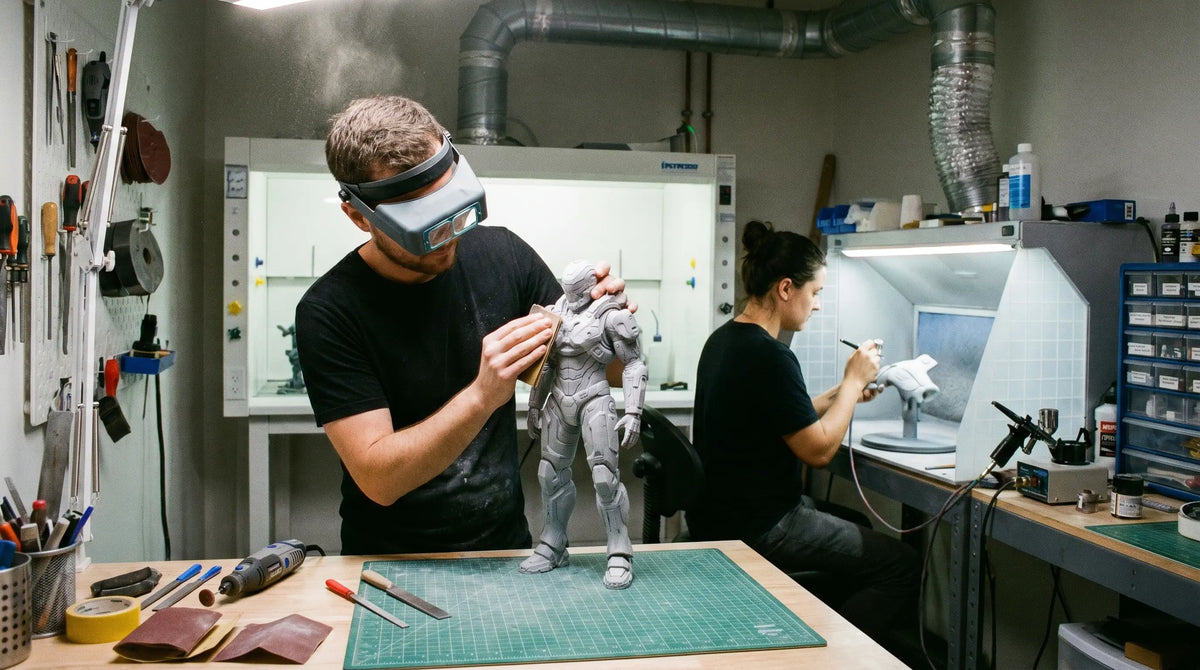
3D print post-processing — sanding, painting and surface treatment
- Emne
- airbrush
- Metoder
- efterbehandling · maling · overflade
- Materialer
- FDM · SLA
- Omfang
- 1622 ord · 9 min
- Post-processing is all the work after the print leaves the printer — sanding, priming, painting, polishing and surface treatment.
- Without post-processing, most 3D-printed parts are immediately usable, but with visible layer lines and a rough surface.
- Professional painting and airbrushing can make an FDM-printed part nearly indistinguishable from injection-molded plastic.
- Maker Factory offers post-processing as an add-on service — you avoid the equipment, chemicals and time investment.
- The choice of post-processing depends on material type, application and surface quality requirements.
Table of contents
- What is 3D printing post-processing?
- The main post-processing methods
- When do you choose professional post-processing?
- What can be post-processed — and how?
- Post-processing at Maker Factory
- What does post-processing cost?
- FAQ about 3D printing post-processing
What is 3D printing post-processing?
When a 3D print leaves the printer, it's technically finished — but rarely presentation-ready. 3D printing post-processing covers all the processes that improve a print's surface, strength or appearance after the printing process itself is complete. It ranges from simple support removal to professional airbrush painting in matched RAL colors.
FDM prints always have visible layer lines — typically 0.1–0.3 mm high. SLA prints are smoother, but require UV curing and support removal. Neither is ready for customer-facing use without some form of post-processing, unless the layer lines are acceptable for the application.
Post-processing isn't a sign that the print is flawed. It's a planned part of the production flow — the same way machined aluminum parts are always anodized, and injection-molded parts are always painted.
The main post-processing methods
The methods vary significantly in complexity, equipment requirements and result. Here's an overview of the most commonly used ones:
| Method | Suited for | Result | Suited for materials |
|---|---|---|---|
| Manual sanding | Layer-line reduction, dimensional precision | Smoother surface, sharper edges | PLA, PETG, ABS, ASA |
| Priming | Preparation for painting | Fills pores, evens out the surface | All FDM materials |
| Painting and airbrushing | Color, branding, presentation | Professional look, RAL-matched colors | All materials (with primer) |
| Acetone polishing | Full layer-line elimination | Glossy, injection-molded-like surface | ABS (only!) |
| UV curing | Complete curing of resin | Maximum strength and stability | SLA resin |
| Surface coating | Chemical resistance, UV stability | Protected, durable surface | ASA, PA6-CF, TPU |
When do you choose professional post-processing?
Post-processing isn't always necessary — but there are situations where it's the only right choice. Professional post-processing from Maker Factory makes sense when the requirements for surface quality, color or presentation exceed what a raw print can deliver. Here are the three most important scenarios:
Customer-facing parts and trade show prototypes
When a part is going to be presented to customers, investors or at a trade show, the layer lines from FDM printing are unacceptable. A raw print communicates "prototype" — a post-processed part communicates "product." Professional priming, sanding and airbrush painting in the company's brand colors can make a PLA part nearly indistinguishable from a series-produced item.
We see this most often with product development companies that have an investor meeting or trade show day coming up, and need the prototype to look sharp — not like a technical proof of concept.
Functional parts with surface requirements
Many technical applications require a specific surface finish for functional reasons — not just aesthetic ones. Gaskets and sealing elements in TPU work better with a smoother surface. Jigs and fixtures in PA6-CF or PETG-CF used repeatedly wear more slowly with a coating. Medical and food-grade use often requires a non-porous surface, which only priming and coating can deliver.
Color matching and branding
If color is critical — for example for a display product, a branded prop or a color-coded production part — painting with a RAL or Pantone match is the only reliable solution. FDM filament is available in many colors, but color variation from spool to spool and surface roughness give an uneven, matte finish. With primer and airbrushing you get consistent, reproducible color across every part in a batch.
A design company in Aarhus ordered 12 building elements for an architecture model in PLA. The raw prints were dimensionally accurate, but the surface was visibly layered. We sanded, primed and painted all the parts in two RAL colors — the result was a model that went straight to a customer meeting instead of a technical review.
- The part will be presented to customers or at a trade show and the layer lines are unacceptable.
- You need a specific RAL or Pantone color that matches your brand.
- Surface porosity is a problem for the application (sealing, hygiene, chemical exposure).
- You don't have the time, equipment or inclination to sand and paint yourself.
- You need the same finish across a batch of several parts.
What can be post-processed — and how?
The material's properties set the boundaries for which post-processing methods are possible. Here's a guide to the most common FDM and SLA materials:
| Material | Sandable | Paintable | Acetone polishing | Coating |
|---|---|---|---|---|
| PLA | Easy | With primer | Not compatible | |
| PETG | Moderate | With primer | ||
| ABS | Easy | With primer | Smooth finish | |
| ASA | Easy | With primer | UV-stable coating | |
| PA6-CF | Difficult (hard) | Special primer | ||
| SLA Resin | Easy | Direct or with primer |
Post-processing at Maker Factory
At Maker Factory we offer post-processing as an integrated add-on service to our 3D printing service. You don't need to stand there with sandpaper, primer and a spray gun yourself — we handle the whole flow from raw print to ready-to-use part.
Our painting and airbrush service covers:
- Manual sanding and shape preparation — we start with coarse grit and work down to fine grit depending on the desired finish.
- Priming with filler primer — fills the layer lines and gives an even base for painting.
- Airbrush painting in the color of your choice — we match RAL, NCS or Pantone codes, or work from a color code you specify.
- Clear coating and protective coating — for parts exposed to UV, chemicals or mechanical wear.
- UV curing of SLA prints — a standard part of our SLA printing service, included in the price.
Ordering is done as part of your inquiry — just note under "Special requirements" that you want post-processing, and specify the desired finish and color.
What does post-processing cost?
The price of post-processing depends on the part's size, complexity and desired finish. As a rule of thumb, you can expect:
- Sanding and priming: From DKK 150–400 per part depending on size and surface accessibility.
- Painting and airbrushing (one color): From DKK 200–600 per part — includes priming and clear coat.
- Painting with color gradient or multiple colors: Price by agreement — contact us with your inquiry.
- UV curing of SLA: Included in the SLA print price at no extra charge.
For batch orders (5+ identical parts) we always give a discount on post-processing costs, since setup time is spread across several parts.
Does your 3D-printed part need professional post-processing? Send us an inquiry with a photo or STL file, and we'll get back to you with price and lead time.
Request a post-processing quote →FAQ about 3D printing post-processing
Can all 3D-printed parts be painted?
Most FDM and SLA materials can be painted, but they always require a suitable primer first. PLA and PETG are easy to prime and paint. PA6-CF and PEEK require special primer and good surface preparation. TPU can be painted, but paint adhesion is limited — coating is preferable for flexible parts.
Do the layer lines disappear completely after sanding and painting?
With sufficient sanding, filler primer and paint, the layer lines can be reduced to invisible to the naked eye. The printed layer height plays a role — prints with 0.1 mm layers are significantly easier to post-process than 0.3 mm ones. For applications requiring complete layer-line removal, we recommend either SLA (which is naturally smooth) or acetone polishing of ABS.
What's the difference between painting and coating?
Painting is primarily aesthetic — it provides color and finish. Coating is functional — it adds chemical resistance, UV stability or wear resistance on top of the paint surface. For outdoor use, chemical exposure or mechanical wear, we always recommend a clear coat or special coating on top of the paint.
Can I post-process my print myself at home?
Yes, manual sanding and spray painting with filler primers can be done at home with basic equipment. Professional airbrushing and lacquering, on the other hand, require compressed air, a spray booth and experience to achieve an even result without overspray and sagging. For presentation prototypes and customer-facing parts, we always recommend professional post-processing.
Do you offer post-processing on parts you didn't print yourselves?
Yes, we can post-process parts regardless of whether they were printed by us or elsewhere. Just send us the parts with a description of the desired finish and color, and we'll give you a price.
What's the lead time for post-processing?
Post-processing typically adds 2–4 business days to the lead time, depending on complexity and workload. Express orders can sometimes be accommodated — contact us directly if you have a deadline.
Can you match a specific RAL color to our company profile?
Yes. Specify the RAL code, Pantone number or NCS code in your inquiry, and we'll mix the paint to match. We can also work from a color sample or a product you send us for reference.
Post-processing isn't just cosmetic — it's part of the product's function. At Maker Factory we always treat the surface as an integrated part of the delivery, not as an add-on. Contact us if you're unsure which finish suits your project.
Mere fra Blog
 PC 3D printing — polycarbonate for heat and industrial parts
In short — PC (polycarbonate) 3D printing: PC is the strongest and most heat-resistant FDM material for technical parts —...
Læs artiklen →
PC 3D printing — polycarbonate for heat and industrial parts
In short — PC (polycarbonate) 3D printing: PC is the strongest and most heat-resistant FDM material for technical parts —...
Læs artiklen →
 3D printed jigs and fixtures — faster and cheaper than CNC
In short — 3D printed jigs and fixtures: 3D printed jigs and fixtures cost 5–20× less than CNC-machined aluminum and...
Læs artiklen →
3D printed jigs and fixtures — faster and cheaper than CNC
In short — 3D printed jigs and fixtures: 3D printed jigs and fixtures cost 5–20× less than CNC-machined aluminum and...
Læs artiklen →
 Nylon 3D printing — PA6-CF for industry and functional parts
In short — the key facts about nylon 3D printing: Nylon (polyamide) is the strongest FDM material for mechanically loaded...
Læs artiklen →
Nylon 3D printing — PA6-CF for industry and functional parts
In short — the key facts about nylon 3D printing: Nylon (polyamide) is the strongest FDM material for mechanically loaded...
Læs artiklen →