

What does 3D printing cost? How the price is calculated in 2026
- Emne
- Best Practice & Tips
- Omfang
- 2163 ord · 11 min
- Small parts under 50 g typically start at DKK 150-300 in FDM and DKK 250-500 in SLA.
- Price is driven by material, weight, print time and post-processing — not by quantity alone.
- SLA typically runs 30-60% above FDM for the same geometry.
- You can often halve the price by adjusting infill, wall thickness and orientation.
- We always give a concrete quote the same day based on your 3D file.
Last updated: April 10, 2026 · Author: Henrik Beck, Maker Factory · 3D printing since 2013
Table of contents
- What does 3D printing cost? The short answer
- What affects the price?
- Concrete pricing examples
- FDM vs SLA — the price difference
- How to save on 3D printing
- When is 3D printing cheapest?
- How to get a quote
- FAQ
What does 3D printing cost? The short answer is that the price of 3D printing is rarely a fixed rate — it depends on material, weight, print time and whether the part needs post-processing. But you don't have to guess: in this guide you'll find concrete pricing examples from our shop, so you can assess your project before sending in the file. I've worked with 3D printing since 2013, and the most important rule is that a 50-gram part in PLA and a 50-gram part in PA6-CF don't cost the same — material matters more than weight.
Want to skip straight to a quote? Send your file here or read about our 3D printing service.
What does 3D printing cost? The short answer
As a rule of thumb: a small functional part under 50 grams costs DKK 150-300 in standard FDM materials like PLA and PETG. If the same part needs to be in SLA resin, the price is typically DKK 250-500. Industrial materials like PA6-CF and PC run 30-80% above standard. A medium-sized part at 100-200 g in PLA often costs DKK 400-800, and large parts over 500 g start at DKK 1,000 and up.
It's deliberately hard to give an exact price without seeing the file — because the price changes dramatically depending on whether the part is hollow or solid, whether it requires support structures, and whether we need to sand and paint it afterward. Two parts that weigh the same can easily cost different amounts if one has complicated overhangs requiring a lot of support material, or if it needs to be printed in an orientation that takes twice as long.

What affects the price of 3D printing?
There are five factors that determine what a 3D printing price ends up being. Once you understand them, you can control the price yourself by adjusting your design or your choices.
1. Material
Material is the single biggest factor. PLA and PETG are cheapest — typically DKK 1.5-3 per gram printed. PA6-CF and PETG-CF run DKK 4-8 per gram. SLA resins like Tough Resin and Engineering Resin run DKK 5-10 per gram. Specialty resins for medical or dental use are even higher. The simplest way to compare is to think in terms of price per gram printed — that includes both raw material and machine time.
2. Weight and infill
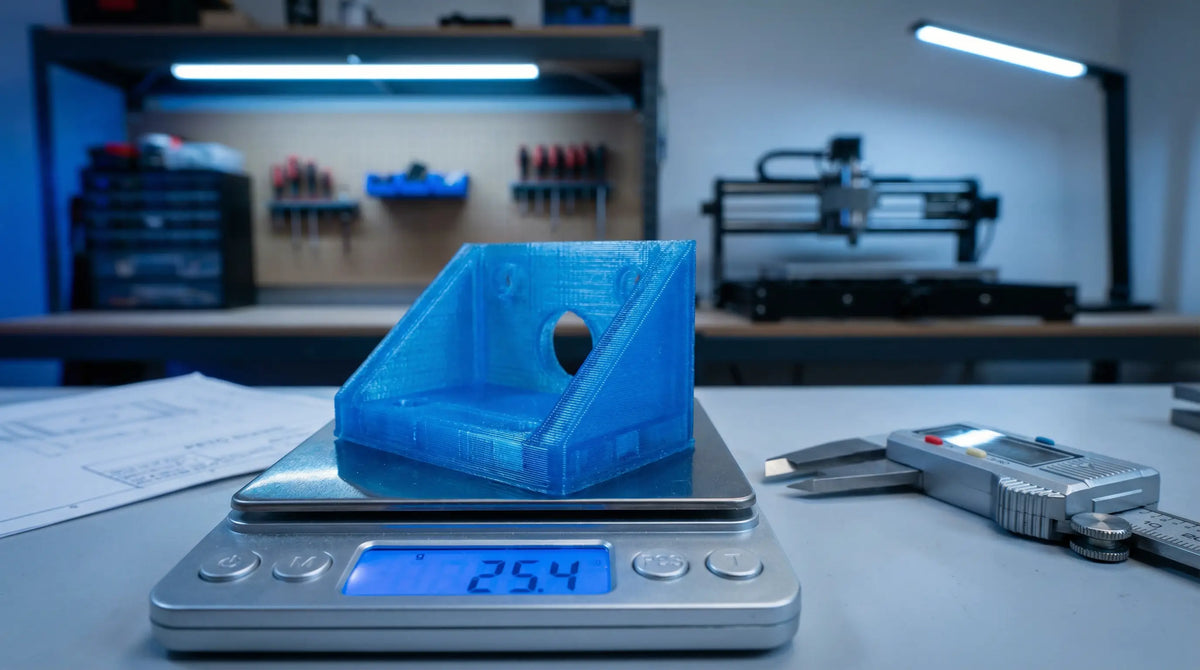
Weight — not volume — determines material use. And you can lower the weight by choosing lower infill (e.g. 20% instead of 100%) if the part doesn't need to be solid. This is often where you save the most. A 100 g part at 100% infill can often be reduced to 40-50 g by printing it with 15% gyroid infill — without losing meaningful strength for most applications.
3. Print time
Our printers use power and machine time, and large or complex parts can take 10+ hours to print. Print time factors into the quote — that's why two parts of the same weight can have different prices if one has complicated support structures that extend print time. Layer height also plays a role: a part printed with 0.12 mm layers (fine finish) takes about 2x as long as the same part with 0.24 mm layers.
4. Post-processing
Does the part need sanding, priming and painting? Does the SLA part need extra curing and finishing? Painting and airbrushing typically adds DKK 200-800 depending on complexity. If the part can stay raw straight off the printer, you save that cost. SLA parts always require a base step (IPA wash + UV curing) that's included in the price — but extra finishing like sanding and painting is an add-on.
5. Quantity and setup
On small batches there's always a setup cost — we need to prepare the file, choose material and plan the print. The price per piece drops quickly when you order several identical parts, because setup is spread across them. At 10+ pieces you typically get a 15-30% discount per piece. At 50+ pieces the price per piece drops further, and above 100 pieces we start considering whether CNC or injection molding is a better alternative.
Small changes to weight distribution, wall thickness and infill can halve the price without making the part weaker. Hollow out the part, use 15-25% gyroid infill, and choose the lightest material that meets the requirements.
Concrete pricing examples from our shop
Here are concrete examples of 3D print service pricing based on real jobs we've done in 2025-2026. Prices are indicative — the final quote depends on your specific file.
| Part | Material | Weight | Price |
|---|---|---|---|
| Small bracket, prototype | PLA | 30 g | DKK 180 |
| Tabletop figure (28 mm) | SLA Miniature Resin | 15 g | DKK 250 |
| Machine replacement part | PETG | 80 g | DKK 420 |
| Industrial fixture housing | PA6-CF | 120 g | DKK 950 |
| Enclosure prototype | ABS | 240 g | DKK 1,100 |
| Batch of 10 brackets | PETG | 30 g × 10 | DKK 1,350 (DKK 135/pc) |
A customer sent an STL for a 180 g solid holder in PA6-CF and got a quote of DKK 1,450. After a quick design review, we recommended hollowing out the part internally and adding gyroid infill — the same part now weighed 72 g, cost DKK 620, and was just as strong in practice. That's the kind of review we do as part of the quoting process whenever the file allows it.
FDM vs SLA — how big is the price difference?
For identical geometry, SLA typically runs 30-60% above FDM. That's because resin is more expensive per gram than filament, and because SLA requires manual post-processing — washing in isopropyl and curing in a UV chamber — which is part of the time spent. In return, you often save on sanding and painting with SLA because the surface is already smooth.
| Factor | FDM | SLA |
|---|---|---|
| Price per gram | DKK 1.5-8 | DKK 5-10 |
| Small part under 50 g | DKK 150-300 | DKK 250-500 |
| Max. size | 256 × 256 × 256 mm+ | ~150 × 85 × 165 mm |
| Post-processing included | Basic (remove support) | IPA wash + UV curing |
| Best for | Functional parts, large parts | Fine detail, smooth surface |
If you're unsure which technology suits your project, read the FDM vs. SLA guide. Short version: FDM wins on functional parts, mechanical strength and large parts. SLA wins on fine detail, smooth surfaces and transparency.
How to save on 3D printing
There are four concrete moves that almost always reduce the price without hurting function:
- Reduce infill — 15-25% gyroid is plenty for most functional parts. 100% infill is rarely necessary.
- Hollow out the part — solid blocks are wasteful. A 2-3 mm shell often gives the same stiffness as a solid block.
- Choose the right material — PETG instead of PA6-CF when carbon fiber isn't needed. PLA instead of ABS when heat isn't critical.
- Order in batches — 10 pieces of the same part is significantly cheaper per piece than 10 separate orders spread over the year.
When is 3D printing the cheapest solution?
3D printing isn't always cheapest — but in specific situations it beats both CNC machining and injection molding on price. Here are the three scenarios where 3D printing typically gives the lowest per-piece price.
- You need 1-100 parts — no tooling cost
- The geometry is too complex for CNC without expensive programming
- You're in the prototyping phase and need to iterate fast
- The spare part is discontinued and the CNC alternative costs 3-5x more
- You want to test the market before investing in injection molding tooling
Low quantities: 1-100 parts with no tooling cost
The biggest price argument for 3D printing is the absence of tooling costs. An injection molding tool typically costs DKK 30,000-150,000 and only makes economic sense at 500+ parts. CNC machining requires programming and fixturing that adds DKK 1,500-5,000 on top of the first part. With 3D printing you only pay for material and print time — the first part costs the same as the tenth. That makes 3D printing clearly the cheapest option for small batches and single parts, especially when the timeline is short.
Complex geometry at no extra cost
In CNC, price rises with complexity — more axes, longer programming, more fixturing setups. In 3D printing, a complicated part with internal channels, thin ribs and organic shapes costs the same as a simple box of the same weight. That means you can design function-optimized parts — cavities, lattice structures, integrated snap-fits — without the price going up. If you have a part that would require 5-axis CNC, 3D printing is almost always cheaper at quantities under 50.
Prototypes and fast iterations
Every iteration in CNC or injection molding costs new programming or new tooling. In 3D printing, a design revision only costs a new print file — and you can have the revised part in hand the next morning. We typically see customers save 60-80% on the prototyping phase by using 3D printing instead of CNC. Combine that with our design service, and you have a complete prototyping cycle of 5-7 business days at a fraction of the cost.
How to get a quote
Send us your STL, STEP or 3MF file, and we'll get back to you with a concrete quote — typically the same day. We review the file, suggest the right material and print strategy, and give you a fixed price before we start. There's no obligation in requesting a quote.
Upload your 3D file and get a concrete quote — typically the same day.
Get a quote →FAQ — 3D printing prices
What does 3D printing cost per gram?
It depends entirely on the material. PLA and PETG typically run DKK 1.5-3 per gram printed. PA6-CF and PETG-CF run DKK 4-8 per gram. SLA resins run DKK 5-10 per gram. Specialty resins for dental and medical use can be twice as expensive.
What affects the price the most?
Material and weight are the two biggest factors. Next comes print time, post-processing and quantity. If you want to push the price down, the first place to look is the design — can the part be hollow or have lower infill?
How much does SLA printing cost?
SLA typically runs 30-60% above FDM for the same geometry. A small SLA part under 50 g starts at DKK 250-500. Large SLA parts are physically limited by the vat size (roughly 150×85 mm), so above that size FDM is often the only practical choice.
Do I get a discount for multiple pieces?
Yes. The setup cost is spread across the quantity, and the price per piece typically drops 15-30% when you order 10 or more of the same part. At 50+ pieces the discount gets even bigger.
Does it cost extra to have the part sanded and painted?
Yes. Post-processing like sanding, priming, painting and airbrushing typically adds DKK 200-800 depending on complexity and size. If the part can stay raw straight off the printer, you save that cost.
How fast can I get a quote?
Typically the same day the file comes in. The print itself is normally delivered within 2-5 business days depending on size, material and the print queue.
Which file formats can you handle?
STL, STEP, 3MF and OBJ cover 99% of what we receive. If you don't have a 3D file yet, we can create the design for you — see our 3D design service.
Want to read more? See also the FDM vs. SLA guide, 3D printing vs. injection molding and background reading on Wikipedia about 3D printing.
Read the step-by-step guide to ordering 3D printing online — from file to delivery. Ordering as a private individual? See 3D printing for private customers.
Maker Factory prints and ships to the whole country — typically 2-3 business days. Read our guide to 3D printing in Copenhagen with lead times, material choices and pricing for Zealand.
Mere fra Blog
 PC 3D printing — polycarbonate for heat and industrial parts
In short — PC (polycarbonate) 3D printing: PC is the strongest and most heat-resistant FDM material for technical parts —...
Læs artiklen →
PC 3D printing — polycarbonate for heat and industrial parts
In short — PC (polycarbonate) 3D printing: PC is the strongest and most heat-resistant FDM material for technical parts —...
Læs artiklen →
 3D printed jigs and fixtures — faster and cheaper than CNC
In short — 3D printed jigs and fixtures: 3D printed jigs and fixtures cost 5–20× less than CNC-machined aluminum and...
Læs artiklen →
3D printed jigs and fixtures — faster and cheaper than CNC
In short — 3D printed jigs and fixtures: 3D printed jigs and fixtures cost 5–20× less than CNC-machined aluminum and...
Læs artiklen →
 Nylon 3D printing — PA6-CF for industry and functional parts
In short — the key facts about nylon 3D printing: Nylon (polyamide) is the strongest FDM material for mechanically loaded...
Læs artiklen →
Nylon 3D printing — PA6-CF for industry and functional parts
In short — the key facts about nylon 3D printing: Nylon (polyamide) is the strongest FDM material for mechanically loaded...
Læs artiklen →