

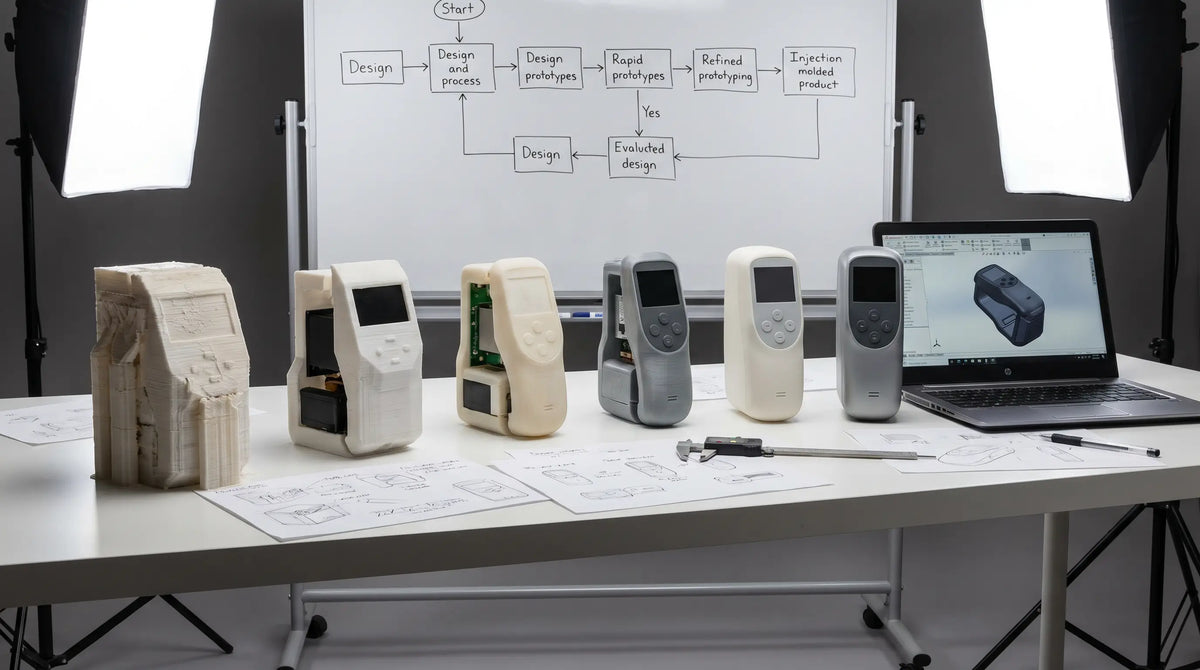
Rapid prototyping with 3D printing — from idea to prototype in 24 hours
- Rapid prototyping means going from digital model to physical prototype in hours to days — not weeks
- 3D printing is today the fastest and cheapest method for functional prototypes in plastic materials
- From STL file to prototype: 24–48 hours at Maker Factory — including delivery across Denmark
- We print in 15+ materials: from affordable PLA to strong PA6-CF and flexible TPU
- No minimum, no tooling costs — perfect for iteration and testing
Table of contents:
What is rapid prototyping? · Methods compared · When is 3D printing the right choice? · Material choice · What does it cost? · FAQ
Rapid prototyping with 3D printing has fundamentally changed the way product developers, engineers, and entrepreneurs work. Where it used to take 4–8 weeks and DKK 15,000–50,000 to get a CNC prototype, today you can have a functional 3D printed prototype in hand within 24 hours for DKK 200–2,000. It's a game-changer for anyone building physical products.
At Maker Factory, we've been helping hundreds of product developers iterate faster and cheaper since 2013. This guide covers what rapid prototyping is, which methods are available, and when 3D printing is the right choice for your project.
Material choice for 3D printing → · What does 3D printing cost? → · 3D design service →
What is rapid prototyping?
Rapid prototyping is the process of quickly creating physical models or functional prototypes directly from digital designs — typically CAD files or 3D models. The purpose is to test form, fit, function, and usability early in the development process, before investing in expensive production tooling such as molds and fixtures.
In 2026, FDM and SLA 3D printing are the dominant rapid prototyping methods for plastic parts, because they're fast, affordable, and can produce geometries that are impossible with traditional machining. According to Danish AM Hub, 30% of Danish industrial companies now use 3D printing — up from 16% in 2018 — primarily for prototyping and bridge production.
Rapid prototyping methods — comparison
| Method | Lead time | Price (simple part) | Best for |
|---|---|---|---|
| FDM 3D printing | 24–72 hours | DKK 200–1,500 | Functional parts, housings |
| SLA 3D printing | 24–72 hours | DKK 300–2,500 | High detail, optics |
| CNC machining | 3–10 days | DKK 2,000–15,000 | Metal, tight tolerance |
| Injection molding | 4–8 weeks | DKK 50,000–500,000 | Mass production >1,000 units |
When is 3D printing the right choice for rapid prototyping?
3D printing isn't the right method for every prototype — but it is for the vast majority in plastic materials. Here are the clear scenarios:
Early concept validation and design iteration
When you're in the early stages of product development and need to test whether the shape is right, whether the ergonomics work, and whether the design looks as expected, 3D printing is unmatched. A series of 3–5 iterations in PLA can be completed in 1–2 weeks for DKK 1,000–3,000 — compared to months and hundreds of thousands for traditional prototype manufacturing.
Function testing with realistic materials
Functional prototyping requires the material to resemble the final product in its properties. We print PA6-CF for customers who need to test stiffness and strength comparable to injection-molded nylon, PETG for testing fit and joints, and TPU for testing seals and gaskets. Specify the use case — we'll recommend the material that gives the most realistic test.
Bridge production before tooling is ready
Many product developers use 3D printing as "bridge production" — they make the first 50–200 units by 3D printing while the injection mold is being made. This typically saves 3–4 months in time-to-market and lets you validate the market before the big investment in tooling. We've delivered bridge production batches to customers in medical devices, IoT, and consumer electronics.
- You need a physical prototype within 24–72 hours
- Designs change frequently and you need fast iterations
- The quantity is under 500 units and a tooling investment is too large
An entrepreneur with a new type of coffee machine component iterated 12 times over 5 weeks — all in 3D print. Once the design was locked, they went straight to injection molding. Total prototype investment: around DKK 18,000. Had they used CNC for all 12 iterations: an estimated DKK 200,000+ and 6 months.
Material choice for prototypes
| Stage | Material | Advantage |
|---|---|---|
| Concept model | PLA | Cheapest, fastest |
| Function testing | PETG | Impact-resistant, durable |
| High detail | SLA Tough Resin | Smooth surface, high precision |
| Strong mechanics | PA6-CF | High strength, carbon fiber |
| Sealing/gaskets | TPU | Flexible, compressible |
What does rapid prototyping cost at Maker Factory?
- Small part (10–50g): DKK 125–350 excl. VAT
- Medium part (50–200g): DKK 350–900 excl. VAT
- Large part or complex geometry: quote on request
Ready for your next prototype? Upload the STL file and get a quote within 24 hours.
Get started →From idea to test result — what rapid prototyping takes in practice
Rapid prototyping isn't just about speed — it's about iteration. The most valuable feature of 3D printing for prototyping isn't that the first prototype is perfect, but that it can be tested and revised faster than the alternatives. A CNC prototype that takes 3 weeks and costs DKK 5,000 can't be iterated 5 times in 6 weeks. A DKK 400 3D printed prototype can.
That's the mathematical reality behind rapid prototyping: the faster you can test and revise, the cheaper it is to make a mistake — and the better the final product becomes. Companies that systematically use 3D printing for prototyping reduce time-to-market and reduce the risk of expensive tooling mistakes.
At Maker Factory, we typically handle 3–7 iterations of a prototype for product development customers. The first prototype clarifies basic geometry and joints. The second clarifies tolerances. The third is typically the one sent for user testing. It's a familiar pattern we see repeated among startups, mid-sized manufacturing companies, and engineering firms.
A typical rapid prototyping order for us: a mechanical engineer sends three STL files with variations of a bracket design. We print all three, deliver packaged and labeled within 48 hours, and receive feedback within the week. The chosen variant is then adjusted and a fourth iteration is sent. Total timeline from first file to finished, approved design: 2–3 weeks.
For prototypes that need to mimic the final product's material properties as closely as possible, we use the material closest to the production material. If the final product will be injection-molded in ABS, we print in ABS or ASA. If it will be molded in nylon, we print in PA6-CF. This gives the most valid test results and the most accurate feedback before the tooling investment.
FAQ — Rapid prototyping
What do I need to order a prototype?
An STL or STEP file is ideal. If you only have an idea or a sketch, we can help with 3D design before printing.
How fast can you deliver?
We offer a standard 2–5 business days and express 1–2 business days on select geometries. Send your file, and we'll specify what's possible.
Can you help with material selection?
Absolutely. Describe what the prototype needs to be used for, and we'll recommend the optimal material for your use case and budget.
What's the difference between FDM and SLA for prototypes?
FDM is cheaper and available in functional materials such as PETG and PA6-CF. SLA gives smoother surfaces and higher detail. Read our FDM vs. SLA guide →
Can you produce batches of 50–200 units?
Yes — we handle bridge production batches. The per-unit price drops at 10+, 25+, and 100+. Contact us for batch pricing.
What if my model isn't printable?
We always check files before production and contact you if there are issues. We offer light design optimization as part of the process.
Rapid prototyping isn't just for product developers and engineering firms. We're seeing a growing segment of trade businesses using 3D printing to prototype custom tools, jigs, and fixtures before investing in steel or aluminum. A carpenter who needs to make 15 identical brackets for a special build prints one PETG prototype, tests it on-site, adjusts the measurement, and then prints the final batch. That's rapid prototyping in practice — fast, cheap, and precise.
An important distinction: rapid prototyping for verification and rapid prototyping for function testing are two different things and require two different materials. For verification (do the dimensions fit? does it look right?), PLA is sufficient and cheapest. For function testing (does it withstand the load? does the seal hold?), we need a material that resembles the final product — PETG, ASA, or PA6-CF depending on the application.
We always advise on this choice in the quote. It's one of the most valuable parts of our service — matching the material to the test purpose, not just the up-front price.
Mere fra Blog
 PC 3D printing — polycarbonate for heat and industrial parts
In short — PC (polycarbonate) 3D printing: PC is the strongest and most heat-resistant FDM material for technical parts —...
Læs artiklen →
PC 3D printing — polycarbonate for heat and industrial parts
In short — PC (polycarbonate) 3D printing: PC is the strongest and most heat-resistant FDM material for technical parts —...
Læs artiklen →
 3D printed jigs and fixtures — faster and cheaper than CNC
In short — 3D printed jigs and fixtures: 3D printed jigs and fixtures cost 5–20× less than CNC-machined aluminum and...
Læs artiklen →
3D printed jigs and fixtures — faster and cheaper than CNC
In short — 3D printed jigs and fixtures: 3D printed jigs and fixtures cost 5–20× less than CNC-machined aluminum and...
Læs artiklen →
 Nylon 3D printing — PA6-CF for industry and functional parts
In short — the key facts about nylon 3D printing: Nylon (polyamide) is the strongest FDM material for mechanically loaded...
Læs artiklen →
Nylon 3D printing — PA6-CF for industry and functional parts
In short — the key facts about nylon 3D printing: Nylon (polyamide) is the strongest FDM material for mechanically loaded...
Læs artiklen →