

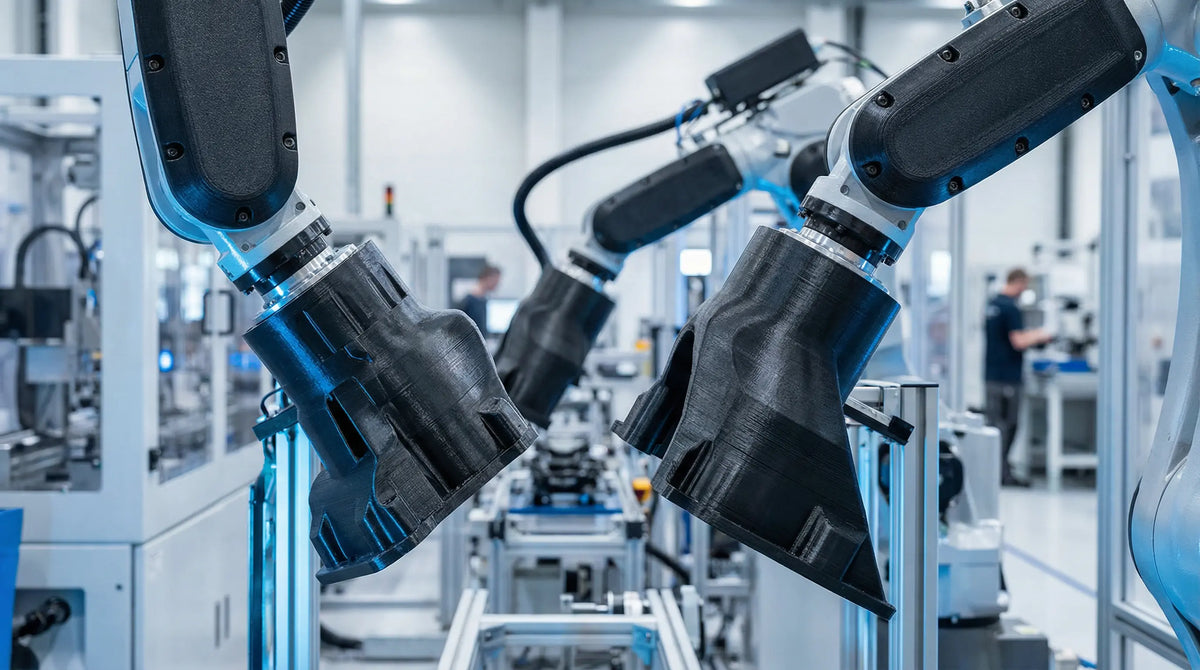
3D print production — when does it replace traditional manufacturing?
- Emne
- Produktudvikling
- Omfang
- 2263 ord · 12 min
Maker Factory prints and ships from Varde nationwide — typically 2-3 business days. Read our guide to 3D printing in Copenhagen with delivery times, material choices and prices for Zealand.
Do you have machines with discontinued components? Read about 3D-printed spare parts for industry. Or are you in the prototyping phase? See rapid prototyping with 3D printing.
- 3D print production is a competitive alternative to CNC machining and injection molding — especially for series under 500 pieces and complex geometries.
- Traditional manufacturing wins for large volumes above 1,000 pieces, high requirements for metal alloys and tight tolerances in steel.
- Additive manufacturing eliminates tooling costs entirely — this is precisely where it beats injection molding economically for low and medium series.
- Spare parts, functional prototypes and custom components are the three task types where 3D printing consistently delivers faster and cheaper than the alternatives.
- At Maker Factory we run FDM and SLA around the clock and typically deliver within 2–5 business days to businesses across Denmark.
Table of contents
- What is 3D print production?
- When do you choose 3D printing over traditional manufacturing?
- Prototypes and product development
- Spare parts and critical components
- Batch Production at low volumes
- 3D printing vs. CNC vs. injection molding
- Industrial 3D printing at Maker Factory
- What does it cost?
- FAQ
3D print production is today a genuine part of the manufacturing chain in Danish industry — not just a proof-of-concept tool. Companies in machine building, electronics, medtech and consumer products use additive manufacturing to produce functional components, spare parts and series items directly from a digital file. The question is no longer whether 3D printing works. The question is when it makes better sense than CNC machining, turning or injection molding. Dansk Industri points to additive manufacturing as one of the technologies increasingly being integrated into Danish SMEs' production flows.
The answer doesn't depend on the technology alone — it depends on volume, geometry, material and lead time. This article gives you the concrete decision rules.
What is 3D print production?
3D print production — also called additive manufacturing — is a manufacturing method where material is built up layer by layer from a digital 3D file. It's the opposite of subtractive manufacturing like CNC machining, where material is removed from a workpiece. Additive manufacturing means that, in theory, no material is wasted, and that geometries can be produced that aren't possible with traditional methods.
The two primary technologies in an industrial context are:
- FDM (Fused Deposition Modeling) — melts plastic filament and lays it down layer by layer. Well suited for functional prototypes, brackets, housings and series parts in PLA, PETG, PA6-CF and ASA.
- SLA (Stereolithography) — cures liquid resin with a UV laser. Well suited for high detail, medical components and precision parts.
Both technologies are available at Maker Factory's 3D printing service. We run FDM and SLA around the clock from our production facilities in Varde.
When do you choose 3D printing over traditional manufacturing?
3D print production isn't the right solution for every task — nor is it meant to be. But there are specific situations where additive manufacturing consistently beats CNC and injection molding on both price and lead time. It primarily comes down to three factors: series size, geometric complexity and the need for fast iteration.
Here are the situations where 3D print production consistently delivers better results than traditional methods:
- You need 1–500 pieces of a component and want to avoid investing in a mold (typically DKK 15,000–150,000 for an injection mold).
- Your component has internal channels, overhanging geometries or organic shapes that require five-axis CNC or expensive wire-EDM electrodes.
- You need a functional prototype within 2–3 days — not 3–6 weeks.
- You need to produce spare parts for machines where the original component has been discontinued by the supplier.
- Your product is under active development and the geometry changes from iteration to iteration — a re-tooled mold is a sunk cost.
- You're producing customer-specific variants of the same base component (custom housings, brackets, assembly fixtures).
- Your timeline doesn't allow for 4–8 weeks for support tooling and a production run at an injection molding company.
Prototypes and product development
The most obvious use case for 3D print production is the prototyping phase — but many underestimate how far the technology has come here. Today we print functional prototypes in PA6-CF (carbon-fiber nylon) and PETG-CF that can be tested directly under real operating conditions. These aren't display models. They're components that can be mounted, loaded and tested in a production environment.
The critical point in product development is that a design change in 3D printing costs nothing in tooling costs. You change the file and print again. At an injection molding company, a change to the mold core typically costs DKK 5,000–30,000 and 2–4 weeks of waiting. For a product going through 5–10 design iterations before approval, the math quickly speaks for itself.
Spare parts and critical components
Industrial 3D printing solves a concrete logistics problem familiar to many Danish production companies: the machine is standing still because a plastic bracket, a housing or a control component has broken — and the lead time from the original supplier is 6–12 weeks, or the component has been discontinued entirely. Here, 3D-printed spare parts are the only real solution.
We've solved this type of task many times — from the food industry to automation companies. A CAD file, a day on the print bed, and the component is ready for installation. Material choice is determined by load and temperature: simple control brackets in PLA, mechanically loaded parts in PETG or PA6-CF, high-temperature parts in ASA or PC. See our full FDM material overview for specifications.
Batch Production at low volumes
3D print batch production — that is, repeated manufacturing of the same component in larger numbers — offers better economics than injection molding as long as the series stays below a certain volume. The threshold typically sits at 300–800 pieces depending on the component's geometry and the chosen material. Below that threshold there's no mold to depreciate, and the price per print is predictable and scalable.
Above 1,000 pieces, injection molding starts becoming competitive because the mold is depreciated and the cycle time per part is shorter than the print time. But at 50, 100 or 200 pieces, 3D print production is almost always the cheapest and fastest route to market.
- The series is under 500 pieces and you want to avoid investing in a mold.
- The component has complex geometry requiring five-axis CNC or special electrodes.
- You need delivery within 2–5 business days.
- The design is under iteration and the geometry may change.
- You need to produce spare parts for machines with discontinued original parts.
- The series exceeds 1,000 pieces and the geometry is simple enough for fast molding.
- The component must be manufactured in aluminum, steel or another metal under high mechanical load.
- Surface tolerances are under ±0.1 mm and require machined finish.
- The material must be certified to specific standards (e.g. ISO 10993 for medical materials).
A Danish automation company contacted us about a control component for an older packaging line — the original supplier had gone bankrupt and no replacement existed on the market. We reconstructed the geometry from a physical sample, printed it in PA6-CF and delivered 12 pieces within three business days. The line was running again the same week. This kind of task isn't the exception — it's a growing share of our industrial order intake.
3D printing vs. CNC vs. injection molding — comparison
The table below compares the three primary manufacturing methods on the parameters that typically decide the choice in an industrial context.
| Parameter | 3D printing (FDM/SLA) | CNC machining | Injection molding |
|---|---|---|---|
| Startup cost | None (DKK 0) | Low–medium (setup) | High (DKK 15,000–150,000) |
| Price per piece, low series (<100 pcs.) | Low–medium | Medium–high | Very high (mold not depreciated) |
| Price per piece, high series (>1,000 pcs.) | Medium | Medium | Low (mold depreciated) |
| Lead time (first part) | 1–5 business days | 3–10 business days | 4–12 weeks (incl. mold production) |
| Geometric freedom | Very high | Medium (depends on axis) | Limited (draft, undercuts) |
| Materials (plastic) | PLA, PETG, PA6-CF, TPU, ASA, PC, SLA resin | Acetal, nylon, PTFE, PC | PP, ABS, nylon, PC (broad range) |
| Design change | Free (new file) | Low extra cost | Expensive (mold modification) |
| Dimensional tolerance | ±0.2–0.3 mm (FDM) / ±0.05 mm (SLA) | ±0.01–0.05 mm | ±0.1–0.3 mm |
Industrial 3D printing at Maker Factory
We deliver industrial 3D printing to companies across Denmark — from single parts to ongoing series deliveries. Our production setup is built for business customers with requirements for lead time and material specifications. We work primarily with FDM technology on Bambu Lab X1-Carbon printers and SLA via our SLA service.
Typical industrial tasks we solve:
- Assembly fixtures and jigs for production lines
- Functional prototypes for mechanical testing and approval
- Spare parts for machines with discontinued original parts
- Custom brackets and adapters for machine integration
- Enclosure parts and housings for electronic components
- Packaging and positioning inserts for production flow
We work with companies of all sizes — from sole proprietors who need one custom bracket, to production companies with ongoing needs for 50–300 pieces per order. NDAs and confidentiality are standard for us.
Technical specifications — FDM vs. SLA
| Specification | FDM (Bambu Lab X1-C) | SLA (Resin) |
|---|---|---|
| Build volume | 256 × 256 × 256 mm | Up to 218 × 123 × 260 mm |
| Layer height | 0.05–0.35 mm | 0.025–0.1 mm |
| Dimensional tolerance | ±0.2 mm | ±0.05 mm |
| Max. operating temperature (material) | Up to 140°C (PC) | Up to 238°C (High Temp Resin) |
| Tensile strength (typical) | 30–80 MPa (material-dependent) | 25–65 MPa |
| Typical lead time | 1–3 business days | 2–5 business days |
What does 3D print production cost at Maker Factory?
The price of 3D print production is calculated primarily from print time, material usage and any post-processing. There's no startup cost and no minimum order. A single component costs the same per piece as 10 of the same component — that's the strength of additive manufacturing.
As a rule of thumb:
- Small components (up to 5 × 5 × 5 cm): typically DKK 80–250 per piece in PLA or PETG
- Medium-sized components (up to 15 × 15 × 10 cm): typically DKK 200–800 per piece
- Technical materials (PA6-CF, PC, ASA): a 30–80% premium over standard materials
- SLA printing (high detail): typically DKK 150–600 per piece depending on volume and resin type
The fastest thing you can do is send us your 3D file directly — we'll give you a precise price the same day.
Have a component that needs to be produced? Send your file and get a price within 24 hours.
Send your file and get a quote →FAQ — 3D print production in Danish industry
When is 3D printing cheaper than CNC machining?
3D printing is typically cheaper than CNC when the component has complex geometry requiring many setups, or when the series is under 50–100 pieces. CNC has lower material cost per piece on simple geometries, but setup time and programming time make it more expensive at low volumes. As a rule of thumb: under 20 pieces, 3D printing almost always wins on total price.
Can 3D-printed parts be used in real production environments?
Yes — with the right material choice. PA6-CF (carbon-fiber-reinforced nylon) withstands mechanical load, ASA withstands UV and weather, PC handles temperatures up to 140°C, and engineering resin from SLA is used in medical and dental contexts. Not all parts are suited for 3D printing, but a growing number of industrial components are today produced additively instead of subtractively.
What is the lead time for industrial 3D printing?
At Maker Factory, standard lead time is 2–5 business days for most tasks. Rush orders can often be delivered within 24–48 hours for an express fee. Lead time depends on the component's size, the chosen material and the number of pieces.
What's the difference between FDM and SLA for industrial use?
FDM is the right technology for functional parts that need to withstand load — brackets, housings, fixtures, spare parts. SLA offers higher detail and smoother surfaces and is used primarily for precision components, medical equipment and parts with tight tolerance requirements. The two technologies complement each other and we use both in production.
Can Maker Factory handle ongoing series deliveries?
Yes. We deliver to companies with ongoing needs — from monthly deliveries of 20–50 pieces to single orders of up to 300–500 pieces. We store customers' files and settings so reordering is fast and the result is identical every time. Contact us to arrange a framework agreement.
When is 3D print manufacturing not the right solution?
3D print manufacturing isn't suited for components that require metal alloys under high dynamic load, surface tolerances under ±0.05 mm without post-processing, or series above 1,000–2,000 pieces in simple geometries. In those cases, CNC machining or injection molding is the better investment.
What should I send to get a price for 3D print production?
A 3D file in STL or STEP format is ideal. Don't have a file? We can help with 3D design and modeling — we typically work in Autodesk Fusion 360. Briefly describe material requirements, number of pieces and desired lead time, and we'll get back to you with a price the same day.
Mere fra Blog
 PC 3D printing — polycarbonate for heat and industrial parts
In short — PC (polycarbonate) 3D printing: PC is the strongest and most heat-resistant FDM material for technical parts —...
Læs artiklen →
PC 3D printing — polycarbonate for heat and industrial parts
In short — PC (polycarbonate) 3D printing: PC is the strongest and most heat-resistant FDM material for technical parts —...
Læs artiklen →
 3D printed jigs and fixtures — faster and cheaper than CNC
In short — 3D printed jigs and fixtures: 3D printed jigs and fixtures cost 5–20× less than CNC-machined aluminum and...
Læs artiklen →
3D printed jigs and fixtures — faster and cheaper than CNC
In short — 3D printed jigs and fixtures: 3D printed jigs and fixtures cost 5–20× less than CNC-machined aluminum and...
Læs artiklen →
 Nylon 3D printing — PA6-CF for industry and functional parts
In short — the key facts about nylon 3D printing: Nylon (polyamide) is the strongest FDM material for mechanically loaded...
Læs artiklen →
Nylon 3D printing — PA6-CF for industry and functional parts
In short — the key facts about nylon 3D printing: Nylon (polyamide) is the strongest FDM material for mechanically loaded...
Læs artiklen →