

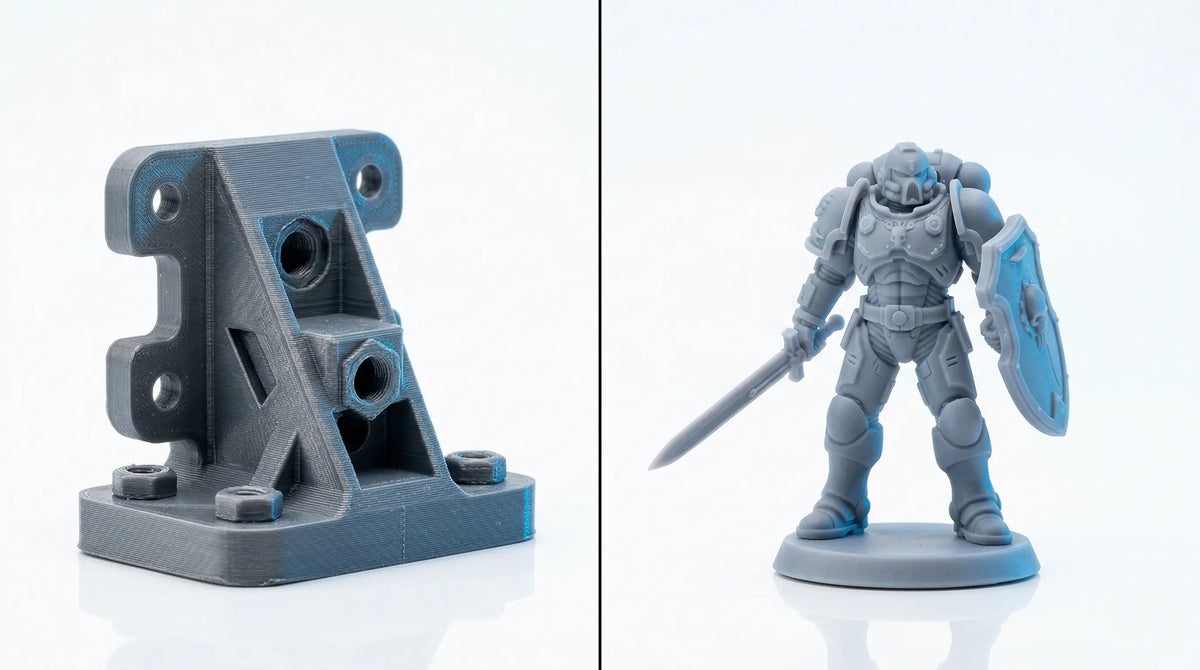
FDM vs SLA: What should you choose?
- Emne
- Teknologi & Materialer
- Omfang
- 1638 ord · 9 min
- FDM is fast, affordable, and good for larger functional parts — it melts thermoplastic filament such as PLA, PETG, nylon, and PA6-CF.
- SLA is precise and delivers smooth surfaces — it cures UV resin with a laser, ideal for fine detail, miniatures, and optics.
- FDM wins on mechanical strength, heat resistance, and large parts. SLA wins on detail, surface quality, and transparency.
- Price: FDM typically DKK 2–5/gram · SLA typically DKK 4–8/gram depending on material and complexity.
Last updated: April 10, 2026 · Author: Henrik Beck, Maker Factory · 3D printing since 2013
FDM vs SLA is the first decision you need to make when a part is going to be 3D printed. The two technologies solve different problems — and the difference isn't about which is newer, but about what the part needs to do, how precise it needs to be, and which material makes sense for the job. I've worked with both technologies since 2013, and the single factor that most often decides the choice is whether the part needs to be functional (mechanical load, heat, wear) or visual (detail, surface, transparency).

Quick comparison: FDM vs SLA
| Parameter | FDM | SLA |
|---|---|---|
| Strength and toughness | High (PA6-CF, nylon, PETG) | Low–medium, more brittle |
| Level of detail | 0.2–0.4 mm | 0.05–0.1 mm |
| Surface | Visible layer lines | Smooth and professional |
| Heat resistance | Up to 180 °C (PA6-CF) | Up to 80 °C (standard) |
| Transparency | Not possible | Yes (clear resin) |
| Max. size | 400×400 mm+ | Approx. 150×85 mm |
| Price (small part) | DKK 150–300 | DKK 250–500 |
| Post-processing | Minimal | IPA wash + UV curing |
What are FDM and SLA?
FDM (Fused Deposition Modeling)
FDM stands for "fused deposition modeling." The printer's nozzle heats a thermoplastic filament — typically PLA, PETG, ABS, or nylon — and deposits it layer by layer onto a heated print bed. The nozzle moves in the X, Y, and Z directions, and the plastic solidifies immediately after being laid down. It's the most widely used 3D printing technology in the world, because it's affordable, scalable, and supports a broad range of materials. Read more about our FDM service.
SLA (Stereolithography)
SLA stands for "stereolithography." A UV laser traces the cross-section of the part into a tank of liquid photo-curable resin, and the resin cures precisely where the laser hits it. The layer is lowered, and the process repeats. SLA is the oldest 3D printing technology of all (patented in 1986) and remains the benchmark for surface quality and level of detail. Read more about our SLA service or our in-depth SLA guide.

When should you choose FDM?
FDM is the right choice when the part needs to be functional — when it needs to withstand mechanical load, heat, or repeated use. FDM parts are tougher and more impact-resistant than SLA parts, and the material range covers everything from affordable PLA to industrial composites such as PA6-CF.
- The part needs to withstand mechanical load, vibration, or repeated use
- It needs to work in a hot environment (engine bay, plant room, machinery)
- The part is larger than 150 mm in any dimension
- You need chemical resistance (oil, fuel, cleaning agents)
- You need to print many iterations cheaply during development
- The part needs to be made in PA6-CF, nylon, PETG, or polycarbonate
Larger parts and fixtures
FDM is essentially the only practical choice when the part is over 150 mm in any dimension. Our FDM printers can handle parts up to 400×400 mm in a single print, meaning you can create a fully functional robot gripper housing, an assembly fixture, or a mounting jig without splitting the design up and gluing it together afterward. The SLA tank is physically limited — typically to around 150×85 mm — so large parts are technologically ruled out.
Mechanical strength and wear resistance
FDM materials such as nylon (PA6), PETG, and the carbon fiber-reinforced composites are significantly tougher than SLA resins. If the part needs to be opened and closed 10,000 times, carry a motor, or withstand vibration in a machine, you choose FDM. SLA parts are typically more brittle and better suited to static components where appearance matters more than wear resistance.
Heat resistance
If the part needs to be used in a heated environment — for example in an engine bay, on a machine that runs hot, or in a plant room — FDM is almost always the answer. PA6-CF and polycarbonate withstand continuous operation up to 120 °C and brief peaks around 180 °C. Most standard SLA resins already start to fail at 60–80 °C, and specialty high-temperature resins rarely exceed 120 °C.
When should you choose SLA?
SLA is the right choice when the part needs to be precise and beautiful — when appearance, fine detail, and smooth surfaces matter more than pure mechanical strength. The SLA process doesn't leave visible layer lines the way FDM does, and the precision is nearly ten times higher.
- The part needs fine detail down to 0.05 mm (textures, small gears, snap-fits)
- The surface needs to be smooth with no visible layer lines
- You need transparent resin for lenses, light guides, or optics
- The part is a miniature or a piece of jewelry under 50 mm
- It needs to be biocompatible (dental, medical, surgical guides)
- The part is static and appearance matters more than wear resistance
High level of detail and fine features
SLA reproduces detail down to about 0.05 mm — around ten times finer than standard FDM. That's essential when making gears, small snap-fits, textured surfaces, or miniature figures where every millimeter counts. FDM simply can't perform at the same level, because the nozzle opening (typically 0.4 mm) sets the physical limit on how small a detail can be reproduced.
Smooth surfaces with no layer lines
FDM parts have visible layer lines because the filament is deposited stripe by stripe. SLA parts come out of the printer almost completely smooth — you can still make out the layers up close, but they're invisible from a meter away, and they disappear entirely after light sanding and painting. If the part needs to look "manufactured" rather than "3D printed," you choose SLA.
Transparency and optics
SLA has transparent resins clear enough for lenses, light-guide channels, and see-through prototypes. FDM can't produce truly transparent parts — even the "clear" PLA variants turn milky and hazy because of the layer transitions. For anything optics-related, SLA is the only practical choice.
I often get customers who bring a miniature figure that was printed in FDM somewhere else. The details have shifted half a millimeter, the face is smeared out, and the weapons look like matchsticks. It's not the printer's fault — it's the choice of technology. The same file in SLA, and every single finger joint and piece of armor detail comes out razor-sharp. If you're printing something under 50 mm where the detail is the whole point, SLA is almost always the answer.
Price comparison: FDM vs SLA
The price of 3D printing depends on size, complexity, material, and post-processing — not just weight. Here are typical price examples from our workshop:
- Small part (10–50 g): FDM DKK 150–300 · SLA DKK 250–500
- Medium part (50–200 g): FDM DKK 300–900 · SLA DKK 600–1,500
- Large part (200+ g): FDM DKK 900–2,500 · SLA rarely possible (tank size)
Material significantly affects the price. PLA and PETG are cheapest, nylon and PA6-CF run 2–3× higher, and specialty resins for dental or medical use can cost double the standard resin. Read more in our dedicated guide What does 3D printing cost?
Not sure which technology fits your project? Send the file — we'll assess it and send a quote the same day.
Get a quote →FAQ — FDM vs SLA
Can I use FDM parts in a heated environment?
Yes. FDM materials such as nylon (PA6) and PA6-CF withstand continuous operation up to about 120 °C and brief peaks around 180 °C. Standard SLA resins already start to fail at 60–80 °C, so for hot applications, FDM is almost always the answer.
Is FDM or SLA better for miniature figures?
SLA is significantly better for miniatures. Detail down to 0.05 mm means faces, weapons, and textures come out exactly as designed. FDM miniatures come out too chunky because the layer lines become visible on small parts.
Can I make transparent parts in FDM?
No — not really. FDM filaments turn milky and hazy because of the layer transitions. SLA has transparent resin that's clear enough for optics, lenses, and see-through prototypes.
How large can an FDM part be?
Our FDM printers typically handle up to 400×400 mm in a single print. Larger parts can be split up and glued or screwed together. SLA is physically limited to around 150×85 mm due to the tank size.
How precise is FDM vs SLA?
FDM has a typical precision of 0.2–0.4 mm depending on the printer and settings. SLA sits at 0.05–0.1 mm — nearly ten times finer. For precision mechanics and fine features, SLA always wins.
Which material should I choose: PLA or PETG?
PLA is cheaper and easier to print, but more brittle and doesn't handle heat well. PETG is stronger, more impact-resistant, and withstands higher temperatures. For functional parts we typically choose PETG or nylon — for visual prototypes, PLA is fine.
Want to read more? Also see our SLA guide, What does 3D printing cost?, and background on Wikipedia's FDM article and Wikipedia's SLA article.
Mere fra Blog
 PC 3D printing — polycarbonate for heat and industrial parts
In short — PC (polycarbonate) 3D printing: PC is the strongest and most heat-resistant FDM material for technical parts —...
Læs artiklen →
PC 3D printing — polycarbonate for heat and industrial parts
In short — PC (polycarbonate) 3D printing: PC is the strongest and most heat-resistant FDM material for technical parts —...
Læs artiklen →
 3D printed jigs and fixtures — faster and cheaper than CNC
In short — 3D printed jigs and fixtures: 3D printed jigs and fixtures cost 5–20× less than CNC-machined aluminum and...
Læs artiklen →
3D printed jigs and fixtures — faster and cheaper than CNC
In short — 3D printed jigs and fixtures: 3D printed jigs and fixtures cost 5–20× less than CNC-machined aluminum and...
Læs artiklen →
 Nylon 3D printing — PA6-CF for industry and functional parts
In short — the key facts about nylon 3D printing: Nylon (polyamide) is the strongest FDM material for mechanically loaded...
Læs artiklen →
Nylon 3D printing — PA6-CF for industry and functional parts
In short — the key facts about nylon 3D printing: Nylon (polyamide) is the strongest FDM material for mechanically loaded...
Læs artiklen →