

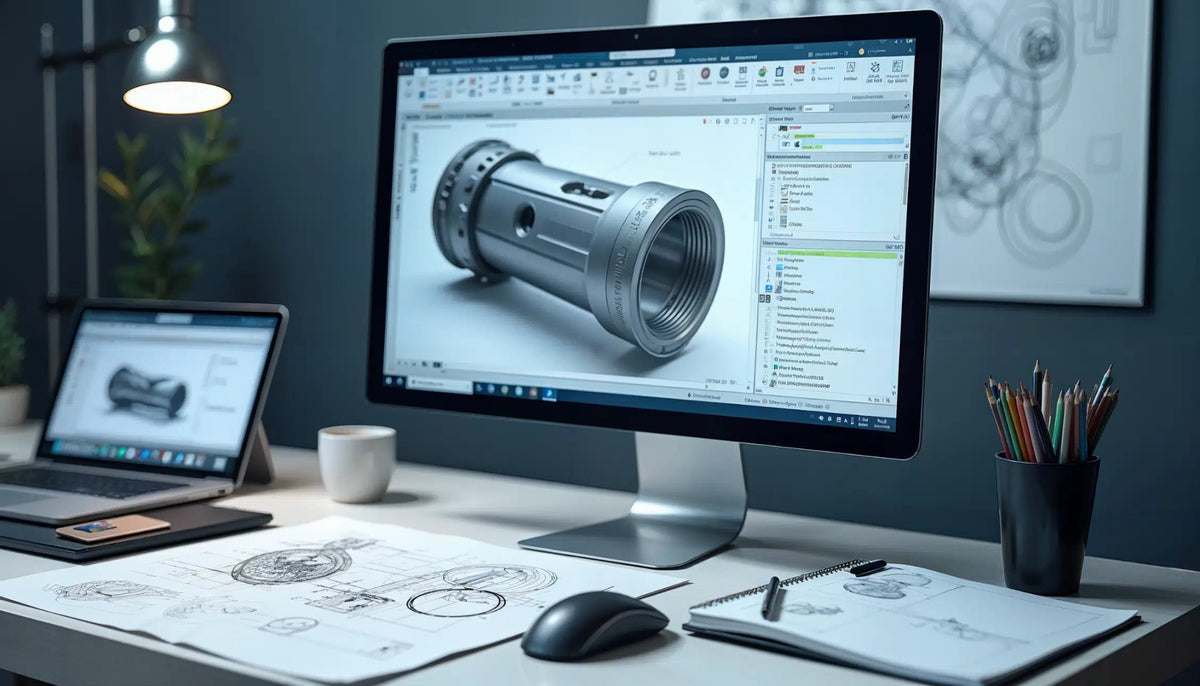
3D printing for product development: From prototype to batch production
- Emne
- Prototype
- Metoder
- Erhverv · Produktudvikling
- Omfang
- 1632 ord · 9 min
- 3D printing cuts prototyping time from weeks to days — you can test and adjust a design within a week
- No mold cost: go from CAD file to physical part with no tooling investment
- Functional prototypes in production materials (PETG, PA6-CF) test real strength and fit
- Pilot batches of 50–500 units are economical with 3D printing — ideal for market testing
- Maker Factory handles the whole process: from 3D design to prototype to batch production
- Why 3D printing for product development?
- From idea to functional prototype in days
- Choosing the right material for your prototype
- 3D printing for small and medium-sized businesses
- The process: 5 steps from idea to batch production
- Typical product development jobs we solve with 3D printing
- What does a 3D printed prototype cost?
- FAQ — 3D printing for product development
Contents
- Why 3D printing for product development?
- From idea to functional prototype in days
- Choosing the right material for your prototype
- 3D printing for small and medium-sized businesses
- The process: 5 steps from idea to batch production
- Typical product development jobs we solve
- What does a 3D printed prototype cost?
- FAQ
3D printing for product development has changed the pace of Danish industry. At Maker Factory, we help companies go from idea to testable prototype in days — not weeks. You save time, money, and risk by physically validating your design before investing in expensive mold production.
This article covers how to use 3D printing strategically in your product development, which materials suit which stages, and what the process looks like from the first sketch to batch production.
Why 3D printing for product development?
Traditional product development often requires CNC-machining prototypes or investing in injection molds. Both are expensive and slow. With 3D printing, that equation changes:
- A functional prototype typically costs DKK 200–2,000 versus DKK 10,000–50,000 for a CNC-machined version
- Lead time is 2–5 business days — not 4–8 weeks
- Design changes are free: fix your CAD file and print again. No new mold, no extra cost
- You can test 4–6 iterations in a week — something that would take months with traditional methods
It's not about replacing all production with 3D printing. It's about using the right technology at the right stage. Read more about 3D printing vs. injection molding.
From idea to functional prototype in days
Most customers who contact us either have a CAD file ready or an idea that needs to be modeled. If you don't have a CAD file, we start with 3D design — we model your part in Fusion 360 based on sketches, measurements, or existing parts.
Visual prototype vs. functional prototype
There's a difference in what you're testing. A visual prototype shows shape and size — it can be printed in PLA in a couple of hours. A functional prototype tests strength, fit, and mechanical function — it requires a production-representative material such as PETG or PA6-CF.
Iterative development — 3D printing's biggest advantage
The real payoff of 3D printing for prototypes is the speed of iteration. You print version 1 on Monday, test it Tuesday, adjust Wednesday, and print version 2 Thursday. This cycle is impossible with CNC or injection molding, where every change costs time and money.
A startup developed an IoT sensor housing. With 3D printing, they ran 7 design iterations in 12 days. The final version fit the PCB, antenna, and mounting points perfectly. Without 3D printing, they'd still be waiting for their first CNC prototype.
Choosing the right material for your prototype
Material choice depends on what you're testing. Here are our recommendations for the most common prototyping scenarios:
| Prototype type | Material | Why |
|---|---|---|
| Shape and size | PLA | Affordable, fast, good detail |
| Mechanical testing | PETG | Strong, durable, withstands load |
| End-product strength | PA6-CF | 100+ MPa, metal replacement |
| Flexible part | TPU | Elastic, shock-absorbing |
| High detail/precision | SLA Engineering Resin | 0.05 mm precision, smooth finish |
Read our complete material guide for a deeper look at all the options.
3D printing for small and medium-sized businesses
3D printing has made product development accessible to companies that previously couldn't afford prototypes. You don't need to invest in expensive molds or minimum orders. Here are the key advantages for SMEs:
No minimum order — print only what you need
Whether you need 1 prototype or 200 units for a pilot batch, you only pay for what you print. No setup cost, no inventory risk. That's especially important for startups and entrepreneurs testing the market with limited capital.
Faster time-to-market
With 3D printing, you can have a product ready for market testing weeks faster than with traditional methods. That time can be decisive in a competitive market — especially for tech startups and product companies.
Custom products as a business model
3D printing makes it possible to offer individual customization at no extra cost. Custom brackets, tailored covers, unique assembly parts — each unit can be unique. For small businesses, that's a competitive edge over large manufacturers locked into standard production.
The process: 5 steps from idea to batch production
- Design or modeling — Have a CAD file? We check it for printability. Only have a sketch? Our design team models your part
- Material choice — We recommend a material based on the part's function, environment, and budget
- First prototype — Printed, inspected, and shipped to you within 3–5 business days
- Iteration and optimization — You test, we adjust. Typically 2–4 rounds
- Pilot batch or full production — 3D printing for batches under 500 units, or transition to injection molding for larger volumes
Typical product development jobs we solve with 3D printing
- Enclosures and housings for electronics — from IoT sensors to control units
- Assembly jigs and fixtures for production lines
- Functional prototypes for medical equipment
- Spare and replacement parts for machinery and automation
- Grips, buttons, and ergonomic parts for consumer products
- Display models and presentation prototypes for events and trade shows
What does a 3D printed prototype cost?
The price depends on size, material, and complexity. Here are realistic price examples:
- Simple PLA prototype (handheld size): DKK 150–400
- Functional PETG prototype (housing): DKK 300–1,200
- PA6-CF industrial prototype (loaded part): DKK 500–2,500
- High-detail SLA prototype: DKK 400–1,800
- Pilot batch (50 units PETG): DKK 5,000–15,000
Read our detailed pricing guide to understand what drives the price.
Ready to start your product development with 3D printing? Send us your CAD file or describe your idea — we'll get back to you with a material recommendation and price within 24 hours.
Start your project →FAQ — 3D printing for product development
How fast can I get a prototype?
Typically 3–5 business days from approved design to delivery. For simple parts, it can be even faster. We also offer express delivery for critical projects.
Do I need a CAD file ready?
No — we can model your part based on sketches, measurements, or existing physical parts. Our design team works in Fusion 360 and delivers print-ready files.
Can 3D printed prototypes be used as end products?
Yes, in many cases. With materials such as PA6-CF and PETG, we produce parts that are used directly in operation. Especially for batches under 500 units, 3D printing is often the best solution — even for end products.
What does it cost to change a design between iterations?
Nothing — beyond the new print. You update your CAD file, send it to us, and we print the new version. There's no mold cost or setup time for design changes.
Can you help with design for manufacturing (DfAM)?
Yes. Design for Additive Manufacturing is a core competency of ours. We optimize your design for 3D printing — correct orientation, optimal support placement, and material choice that matches your requirements.
What happens when my design is finished and volume increases?
We help with the transition to batch production. For batches under 500 units, 3D printing is typically most economical. Above 500 units, injection molding can be cheaper — we advise on the right time to switch.
From design to delivery — a typical journey
A typical product development project at Maker Factory starts with a request through the website. We review the requirements — function, tolerances, material, and end use — and deliver a price within 24 hours. Once the order is confirmed, we get started the same day.
The design phase typically takes 1–3 days depending on complexity. We then print the prototype and ship it with PostNord for delivery the next business day. That puts a physical model in your hands within 3–5 days of first contact — a timeline that's impossible to match with traditional manufacturing methods such as CNC machining or injection molding.
A manufacturer of agricultural equipment sent us a broken plastic part from an imported machine — lead time on the original part was 6 weeks. We scanned, reconstructed, and printed a replacement part in PA6-CF within 2 days. The machine was back in production the same week. The customer didn't just save money — they saved production losses during a busy season.
When does 3D printing deliver the most value?
3D printing delivers the most value early in the development process — when you're still testing and adjusting. The more iterations you run, the more time and money you save compared to traditional manufacturing. Once the design is locked and you need to produce large batches, injection molding can take over. But from idea stage to validated prototype, 3D printing is almost always the fastest and cheapest choice — meaning faster time-to-market and lower development costs for your business.
Owner · Maker Factory · 3D Printing Since 2013
CVR 38935836
Henrik has worked with 3D printing since 2013 and went on to found Maker Factory, which delivers FDM and SLA printing to industry, developers, and entrepreneurs across Denmark.
Mere fra Blog
 PC 3D printing — polycarbonate for heat and industrial parts
In short — PC (polycarbonate) 3D printing: PC is the strongest and most heat-resistant FDM material for technical parts —...
Læs artiklen →
PC 3D printing — polycarbonate for heat and industrial parts
In short — PC (polycarbonate) 3D printing: PC is the strongest and most heat-resistant FDM material for technical parts —...
Læs artiklen →
 3D printed jigs and fixtures — faster and cheaper than CNC
In short — 3D printed jigs and fixtures: 3D printed jigs and fixtures cost 5–20× less than CNC-machined aluminum and...
Læs artiklen →
3D printed jigs and fixtures — faster and cheaper than CNC
In short — 3D printed jigs and fixtures: 3D printed jigs and fixtures cost 5–20× less than CNC-machined aluminum and...
Læs artiklen →
 Nylon 3D printing — PA6-CF for industry and functional parts
In short — the key facts about nylon 3D printing: Nylon (polyamide) is the strongest FDM material for mechanically loaded...
Læs artiklen →
Nylon 3D printing — PA6-CF for industry and functional parts
In short — the key facts about nylon 3D printing: Nylon (polyamide) is the strongest FDM material for mechanically loaded...
Læs artiklen →