

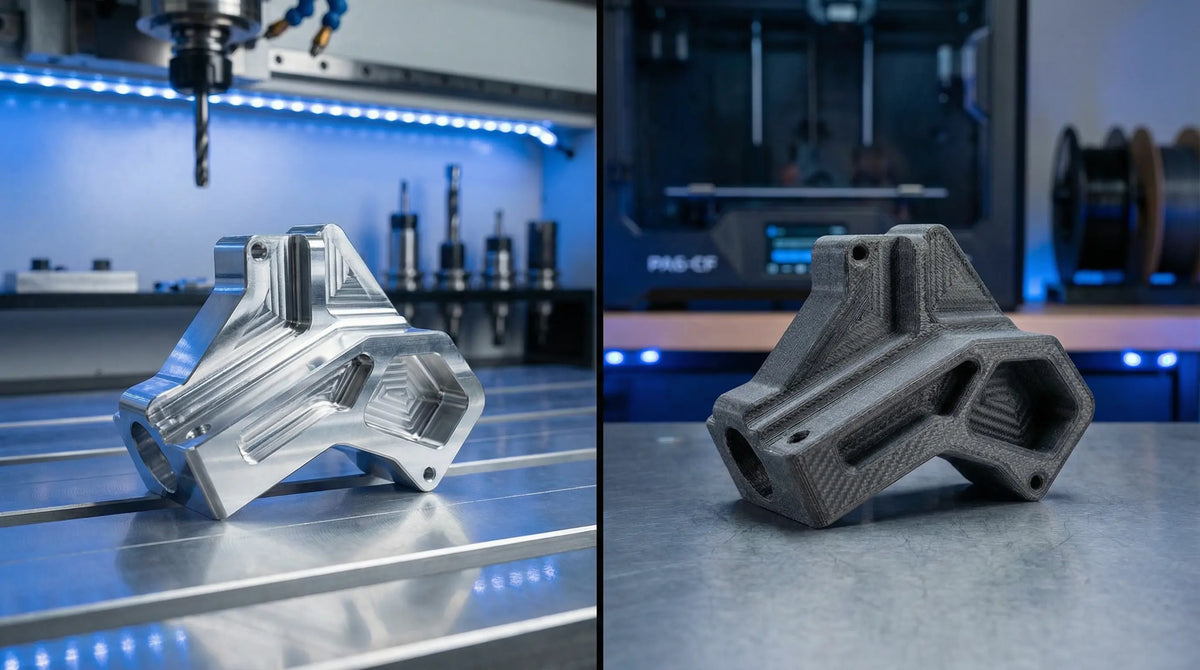
CNC or 3D printing? How to find the right production method
- Emne
- Produktudvikling
- Omfang
- 1644 ord · 9 min
- CNC machining wins on metals, tight tolerances (≤0.02 mm) and large runs in the same material.
- 3D printing wins on complex geometries, fast prototypes, low volume and parts with internal channels.
- Price crossover: under 20-30 pieces, 3D printing is typically cheapest. Above that, CNC or injection molding wins.
- The two technologies aren't mutually exclusive — we often combine a 3D-printed jig with CNC-machined final parts.
Contents
- What are CNC and 3D printing?
- Quick comparison
- When do you choose CNC?
- When do you choose 3D printing?
- Price comparison
- When you combine both
- FAQ
When you're facing a part that needs to be produced, the choice between CNC vs 3D printing is often the first real decision. The two technologies solve different problems — and the difference isn't about what's trendy, but about what the part needs to do, how many you need, and what material it needs to be in. I've worked with both production methods since 2013, and what I see most often is people choosing the wrong one because they don't know their actual tolerance or volume requirements. This guide gives you a concrete decision framework based on real projects.
What are CNC and 3D printing?
CNC machining
CNC machining (Computer Numerical Control) is a subtractive production process: you start with a block of material — typically aluminum, steel, brass, titanium or engineering plastic — and a computer-controlled mill removes material until the part remains. CNC can achieve tolerances down to 0.01-0.02 mm, and the surface finish is often usable straight off the machine without post-processing. The downside is setup: each part requires programming, fixturing and tool changes, and the setup cost alone can run into thousands of kroner.
3D printing
3D printing is the additive opposite: instead of removing material, the part is built up layer by layer. At Maker Factory we primarily use FDM (melted filament) and SLA (UV resin). Tolerances are typically 0.1-0.3 mm, but in return the design freedom is enormous: internal channels, lattices, organic shapes and consolidated assemblies are essentially free. 3D printing has no real setup cost — the price per piece barely changes between 1 and 30 pieces. Read more about our 3D printing service.
Quick comparison: CNC vs 3D printing
| Parameter | CNC machining | 3D printing (FDM/SLA) |
|---|---|---|
| Tolerance | ±0.01-0.02 mm | ±0.1-0.3 mm |
| Materials | Metals, engineering plastics | Thermoplastics, carbon fiber, resin |
| Design freedom | Limited by tool access | Nearly unlimited |
| Internal channels | Very difficult | Free |
| Setup cost | High (programming + fixturing) | Almost none |
| Lead time | 1-3 weeks | 1-5 days |
| Optimal volume | 50-1,000 pcs | 1-30 pcs |
| Certifiable properties | Yes, bulk material | Limited (anisotropy) |
When do you choose CNC over 3D printing?
The choice falls on CNC when the part needs to be in metal, when tolerances need to be under 0.1 mm, or when you need more than 50-100 pieces in the same design.

• The part needs to be in metal (aluminum, steel, brass, titanium)
• Tolerances need to be under 0.1 mm
• You need more than 50-100 pieces in the same design
• Material properties need to be certifiable and traceable
• The surface needs to be smooth straight off the machine
• The component is safety-critical
Metal and certifiable material properties
If the part needs to be in metal — and needs to withstand loads where a failure has consequences — CNC is almost always the right choice. A CNC-machined aluminum part has uniform, documented material properties from bulk stock. A 3D-printed metal part (DMLS or SLM) often has anisotropic strength, porosity, and requires post-processing to approach the same reliability. For businesses in the machinery industry and for safety-critical components, that's usually a dealbreaker.
Tight tolerances under 0.1 mm
If the part needs to fit into a ball bearing, a press fit, or a gear connection, 3D printing is rarely precise enough. FDM typically hits ±0.2-0.3 mm, SLA ±0.1 mm at best — and that's not always consistent across the whole part. CNC routinely hits ±0.02 mm on all critical surfaces.
Large runs with uniform requirements
On a run of 200 identical parts, the CNC price per piece becomes very low, because the setup cost is spread across the whole batch. The crossover point between 3D printing and CNC often falls between 30 and 100 pieces depending on complexity and material. Above 1,000 pieces, injection molding typically wins — read our dedicated guide 3D printing vs. injection molding.
When do you choose 3D printing over CNC?
The choice falls on 3D printing when the part needs to be complex, when you need few pieces, or when you need to iterate fast.
• The geometry is complex — internal channels, lattices, organic shapes
• You need to iterate fast (2-5 versions in one week)
• Volume is under 30 pieces
• The material is thermoplastic or a carbon-fiber composite (PA6-CF, PETG-CF)
• You can consolidate several machined parts into one printed part
• Weight and topology optimization are critical (drones, aerospace)
Complex geometries and internal channels
This is where 3D printing is the clear winner. Internal channels, lattices, honeycombs and organic shapes are free in additive manufacturing. Need to make a heat sink with internal channels that would be impossible to mill? That's exactly the kind of job 3D printing was made for. We've delivered manifolds for hydraulic systems that would have required 12 individual machined parts plus seals — and we printed them in one piece with no joints or leak points.
Fast iteration and prototyping
We often print 2-3 versions of the same part on the same day. Iteration speed is CNC machining's weakest point: every new version requires new programming and new fixturing. In a product development process where you test and adjust weekly, 3D printing is typically 5-10x faster to iterate with.
Low volume and one-off parts
If you need 5-15 pieces, CNC is rarely cost-effective. 3D printing has no setup cost, and the price per piece is close to linear. That makes 3D printing the obvious choice for replacement parts, custom tools and one-off fixtures. Read our guide to 3D printing for businesses for concrete examples.
We had a project for a manufacturer who wanted 12 custom brackets. CNC quote: DKK 14,000 with a 3-week lead time. We printed them in PA6-CF for DKK 4,200 and delivered in 4 business days. Strong enough for the application, and the customer could start testing a week earlier than planned. That kind of math typically holds under 30 pieces.
What does CNC vs 3D printing cost?
At low volume (1-30 pieces), 3D printing is typically 50-70% cheaper than CNC for the same geometry. At large runs (100+ pieces), the picture flips, because CNC's setup cost is spread across more units while 3D printing's material cost stays constant. Here are some indicative price ranges from our shop:
| Scenario | 3D printing | CNC |
|---|---|---|
| Small part · 5 pcs · plastic | DKK 1,000-2,500 | DKK 6,000-12,000 |
| Small part · 50 pcs · aluminum | DKK 7,000-15,000 | DKK 8,000-18,000 (crossover) |
| Small part · 200 pcs · aluminum | DKK 25,000+ | DKK 15,000-25,000 |
These figures are indicative — the actual quote depends on geometry, tolerances and material. Read more in our detailed guide What does 3D printing cost?
When you combine both technologies
The best answer is often not "either/or" but "both". In real production workflows, we regularly use 3D-printed jigs and fixtures to hold CNC-machined parts during machining. We also print prototypes in 3D printing to validate design and fit before the customer orders the final CNC-manufactured run in aluminum. That way you save both time and money: iteration happens cheaply and quickly in additive manufacturing, and final production happens reliably in subtractive.
Upload your CAD file and get a concrete quote — we'll assess whether CNC, 3D printing or a combination suits your project best.
Get a quote →FAQ — CNC vs 3D printing
When is CNC better than 3D printing?
CNC is better when the part needs to be in metal, when tolerances need to be under 0.1 mm, or when you need more than 50-100 pieces. For safety-critical components with certifiable material properties, CNC is almost always the right choice.
Is CNC or 3D printing cheapest?
Under 20-30 pieces, 3D printing is typically 50-70% cheaper than CNC. The crossover point is around 30-100 pieces depending on complexity. Above 100 pieces, CNC wins, and above 1,000 pieces, injection molding wins.
Can you combine CNC and 3D printing?
Yes, and we often do. Typical examples: a 3D-printed jig to hold CNC-machined parts during machining, or 3D-printed prototypes before the final CNC run is ordered in aluminum.
What materials can CNC use?
Aluminum, steel, brass, titanium, copper and engineering plastics like POM, PEEK and PA6. CNC can machine essentially anything that can be fixtured — including composites and fiber-reinforced plastics.
What materials can 3D printing use?
At Maker Factory we primarily print thermoplastic filaments (PLA, PETG, nylon, PA6-CF, PETG-CF, ABS) and UV-curing resins in the SLA process. For metal parts we typically refer customers to CNC or external DMLS suppliers.
How fast can I get my part delivered?
3D printing rarely has any setup time — we can typically print small parts the same day or the day after the file comes in. CNC typically requires 1-3 weeks of lead time due to programming, fixturing and waiting for machine time.
Want to read more? See also the FDM vs. SLA guide, What does 3D printing cost? and background reading on Wikipedia about CNC.
Need to prototype fast? Read about rapid prototyping with 3D printing. Need a spare part? See 3D-printed spare parts for industry.
Mere fra Blog
 PC 3D printing — polycarbonate for heat and industrial parts
In short — PC (polycarbonate) 3D printing: PC is the strongest and most heat-resistant FDM material for technical parts —...
Læs artiklen →
PC 3D printing — polycarbonate for heat and industrial parts
In short — PC (polycarbonate) 3D printing: PC is the strongest and most heat-resistant FDM material for technical parts —...
Læs artiklen →
 3D printed jigs and fixtures — faster and cheaper than CNC
In short — 3D printed jigs and fixtures: 3D printed jigs and fixtures cost 5–20× less than CNC-machined aluminum and...
Læs artiklen →
3D printed jigs and fixtures — faster and cheaper than CNC
In short — 3D printed jigs and fixtures: 3D printed jigs and fixtures cost 5–20× less than CNC-machined aluminum and...
Læs artiklen →
 Nylon 3D printing — PA6-CF for industry and functional parts
In short — the key facts about nylon 3D printing: Nylon (polyamide) is the strongest FDM material for mechanically loaded...
Læs artiklen →
Nylon 3D printing — PA6-CF for industry and functional parts
In short — the key facts about nylon 3D printing: Nylon (polyamide) is the strongest FDM material for mechanically loaded...
Læs artiklen →