

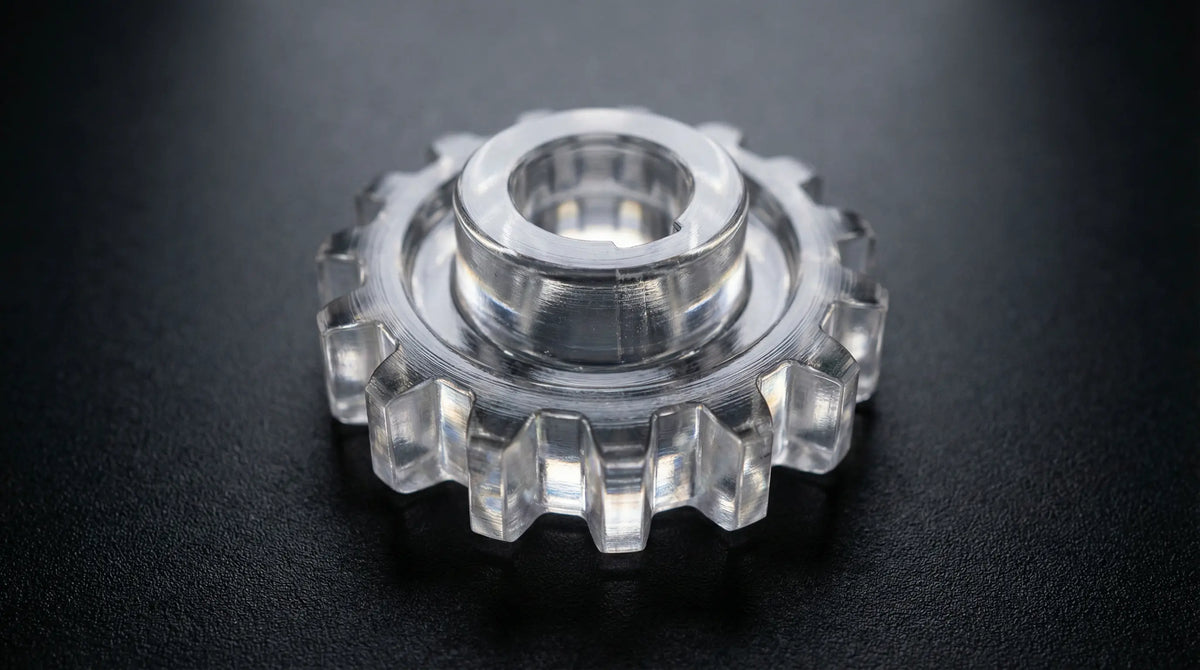
SLA 3D printing — precision and detail for demanding tasks
Play Warhammer or D&D? Read our guide to Warhammer and DnD miniatures in SLA resin — the level of detail FDM can't deliver.
- SLA delivers the sharpest detail and smoothest surfaces of all 3D printing methods.
- Well suited to prototypes, jewelry, dental applications, miniatures and functional resin parts.
- We print in 8 resin materials: engineering, transparent, flex, ceramic and more.
- Layer thickness down to 0.025 mm — detail FDM can't reproduce.
- Quote within 24 hours — upload your file or describe the job.
Last updated: April 9, 2026 · Author: Henrik Beck, Maker Factory · 3D printing since 2013
Table of contents
- What is SLA 3D printing?
- When do you choose SLA over FDM?
- SLA vs. FDM — comparison
- SLA materials at Maker Factory
- Typical jobs we solve with SLA
- Miniature 3D printing for tabletop gaming and hobby
- What does SLA 3D printing cost?
- FAQ
SLA 3D printing is the choice when detail, surface quality and precision matter more than material strength and price. At Maker Factory we offer SLA printing in 8 material types — from standard engineering resin to transparent, flex and high-temperature variants. Read more about SLA technology, our general 3D printing service and the alternative FDM technology.
What is SLA 3D printing?
SLA (Stereolithography) uses a UV laser to cure liquid resin layer by layer. Layer thickness can go down to 0.025 mm — for comparison, a human hair is roughly 70 µm thick. SLA is the oldest 3D printing technology of all (patented in 1986) and remains the benchmark when it comes to surface quality and fine detail.
- A UV laser cures the resin — layer by layer from the bottom up.
- Washing and post-curing — parts are washed in IPA and post-cured under UV light.
- Support removal and finishing — supports are removed and the surface can be post-processed.
When do you choose SLA over FDM?
The choice between SLA and FDM isn't about which technology is "best" — it's about what the job requires. SLA is the right choice when surfaces, detail and precision matter more than price and mechanical properties. Here are the situations where SLA consistently delivers better results:
- Presentation prototypes — SLA parts resemble injection-molded products. The surface is smooth straight off the printer with no sanding.
- Tight tolerances — precision under ±0.1 mm for assemblies, gears and parts that need to fit exactly against each other.
- Fine detail under 1 mm — geometries FDM can't reproduce. Text, logos, rib structures and fine cavities come out sharp.
- Transparent and optical parts — transparent resin can be finished to optical clarity by sanding and polishing.
- Jewelry models and casting — castable resin burns out without residue during investment casting in gold, silver and bronze.
- Dental and medical use — biocompatible resin materials for dental models, surgical guides and orthopedic aids.
- Miniatures and collectible figures — tabletop gaming figures and Warhammer miniatures benefit from SLA's ability to reproduce detail at very small scale.
• Details under 1 mm need to be sharp and legible
• The surface needs to be smooth straight off the printer
• You need transparent, biocompatible or castable materials
• The part is small to medium-sized (up to around 20 cm)
• Presentation quality matters more than mechanical strength
High detail and smooth surface
If your part is small, detailed, or needs to look presentation-ready straight off the printer, SLA is typically the right choice. Narrow geometries, gear teeth, textures and raised text are handled far better in resin. An FDM part that needs to be sandblasted and painted to hide layer lines costs almost the same as an SLA print — with more work and less sharpness.
Transparency and optics
Want a part that's clear or semi-transparent — lens housings, fluid manifolds, display covers — SLA with clear resin is the only 3D printing option that gives an acceptable result. FDM in transparent PETG isn't actually transparent in practice: the layers scatter light and result in a frosted look.
Medical and dental
SLA resin is available in biocompatible variants certified for skin contact and short-term implants. For dental models, surgical guides and orthopedic prototypes, SLA is the standard. FDM materials aren't certified for the same applications — that's a regulatory matter, not a question of quality.
SLA vs. FDM — comparison
| Property | SLA (resin) | FDM (filament) |
|---|---|---|
| Layer thickness | 0.025-0.1 mm | 0.1-0.3 mm |
| Surface | Smooth, injection-molded-like | Visible layer lines |
| Tolerance | ±0.05-0.1 mm | ±0.2-0.4 mm |
| Mechanical strength | More brittle, lower impact strength | Tough, high impact strength (PETG, PA6-CF) |
| Max. size | ~20 × 20 × 25 cm | ~30 × 30 × 60 cm |
| UV resistance | Limited (becomes brittle over time) | Good (ASA) |
| Price per part | Higher (resin + post-processing) | Lower |
| Best for | Detail, prototypes, miniatures, jewelry, dental | Functional parts, large geometries, production runs |
FDM is still the best solution for large mechanical parts, outdoor components and batch production. Not sure which to pick? Read FDM vs. SLA — which method suits your project?
SLA materials at Maker Factory
- Engineering Resin — the default choice for functional prototypes.
- Tough Resin — ABS-like, impact-resistant.
- Transparent Resin — optically clear after post-processing.
- Flex Resin — elastic and bendable.
- PA-like Resin — high tensile strength and stiffness.
- High Temperature Resin — HDT up to 238°C.
- Ceramic Resin — for firing and aesthetic applications.
- Miniature Resin — optimized for ultra-fine detail in miniatures and figurines.
Typical jobs we solve with SLA
- Product prototypes — presentation-ready models ahead of batch production.
- Dental and orthopedics — dental models and surgical guides.
- Jewelry models — castable resin for casting in gold and silver.
- Electronics and optics — enclosures with tight tolerances.
- Architectural models — detailed building models.
- Miniatures and hobby — tabletop gaming figures and collectibles.
We have experience with medical and healthcare, electronics and technology and advertising and events.
Miniature 3D printing for tabletop gaming and hobby
SLA is the technology driving the hobby miniature world. A layer thickness of 0.025-0.05 mm makes it possible to reproduce facial features, armor detail and textures on figures as small as 28 mm.
- Dungeons & Dragons — heroes, monsters and dungeon elements in 28-32 mm scale.
- Warhammer and wargames — infantry and large figures (54 mm+) with sharp armor detail.
- Board games and pieces — unique game pieces, tokens and terrain elements.
- Collectible figures — single figures in 75-120 mm for painting and display.
- Custom characters — your character modeled from a description or STL file.
We use Miniature Resin with low shrinkage — figures are delivered ready for priming and painting with no sanding needed. Got an STL file ready? Figures from Kickstarters, Patreon sets and platforms like MyMiniFactory we print directly. Send the file and quantity — price within 24 hours.
We offer three products for miniatures:
- Figure Package — Design & 3D Printing of Miniatures — no file? We design and print your figure from scratch.
- Hero Print — Miniatures in small batches — 1-24 figures from your own STL files.
- Dungeon Army — Miniatures in large batches — batch printing from 25 pieces. Lowest per-piece price.
What does SLA 3D printing cost at Maker Factory?
- Tabletop gaming figures 28-32 mm: DKK 45-90 per figure.
- Larger figures 54-75 mm: DKK 120-250 per figure.
- Small detailed parts and prototypes (under 5 cm): from DKK 150-350.
- Medium prototypes (5-15 cm): DKK 350-900.
- Specialty materials (ceramic, high-temp, castable): surcharge of 20-40%.
- Batches of 5+ pieces: per-piece price drops — contact us for a batch quote.
Read more about pricing in general in What does 3D printing cost?
The most common mistake I see with SLA jobs is customers choosing SLA for functional parts that should really be FDM. Resin is sharp and beautiful — but it's also more brittle than PETG and nylon. If the part needs to flex, take repeated impact or carry a load repeatedly, send it as FDM instead. Use SLA for what it's good at — detail, surfaces and precision — and you get a result that looks factory-made.
Need it printed in SLA? Upload your file or describe the job — we'll send a fixed price within 24 hours.
Get a quote for SLA printing →Frequently asked questions about SLA 3D printing
What's the difference between SLA and FDM?
FDM melts plastic filament and is best for large, mechanical parts. SLA cures resin with a UV laser and delivers far better detail and surface quality. Choose FDM for function and size, SLA for precision and finish.
Can you print tabletop gaming figures and Warhammer miniatures?
Yes. We print in Miniature Resin with layer thickness down to 0.025 mm. See Figure Package, Hero Print and Dungeon Army.
Can SLA parts be used functionally?
Yes. Tough Resin, Engineering Resin and PA-like Resin offer good strength. High Temperature Resin withstands up to 238°C. Resin is, however, generally more brittle than FDM materials under impact and bending.
How smooth is the surface on SLA prints?
SLA parts come out with a surface quality similar to injection-molded products. Ra values of 1-3 µm with no post-processing. With light sanding and polishing, transparent resin can be made optically clear.
What's the lead time on SLA printing?
Typically 2-4 business days. Rush delivery within 24 hours can be arranged — contact us directly.
Can you print in castable resin for jewelry casting?
Yes. Castable resin for investment casting in gold, silver and bronze. The model burns out with no ash residue. Contact us with your specs.
What does my file need to meet for SLA printing?
We accept STL, STEP and OBJ. Minimum detail is 0.3 mm. Minimum wall thickness is at least 0.8 mm. Send the file and we'll review it free of charge before printing.
Want to read more? See also FDM vs. SLA — which method suits your project? and What does 3D printing cost?. Background on the technology on Wikipedia about stereolithography.
Also read: Resin for 3D printing – the complete guide to resin types.
Mere fra Blog
 PC 3D printing — polycarbonate for heat and industrial parts
In short — PC (polycarbonate) 3D printing: PC is the strongest and most heat-resistant FDM material for technical parts —...
Læs artiklen →
PC 3D printing — polycarbonate for heat and industrial parts
In short — PC (polycarbonate) 3D printing: PC is the strongest and most heat-resistant FDM material for technical parts —...
Læs artiklen →
 3D printed jigs and fixtures — faster and cheaper than CNC
In short — 3D printed jigs and fixtures: 3D printed jigs and fixtures cost 5–20× less than CNC-machined aluminum and...
Læs artiklen →
3D printed jigs and fixtures — faster and cheaper than CNC
In short — 3D printed jigs and fixtures: 3D printed jigs and fixtures cost 5–20× less than CNC-machined aluminum and...
Læs artiklen →
 Nylon 3D printing — PA6-CF for industry and functional parts
In short — the key facts about nylon 3D printing: Nylon (polyamide) is the strongest FDM material for mechanically loaded...
Læs artiklen →
Nylon 3D printing — PA6-CF for industry and functional parts
In short — the key facts about nylon 3D printing: Nylon (polyamide) is the strongest FDM material for mechanically loaded...
Læs artiklen →