

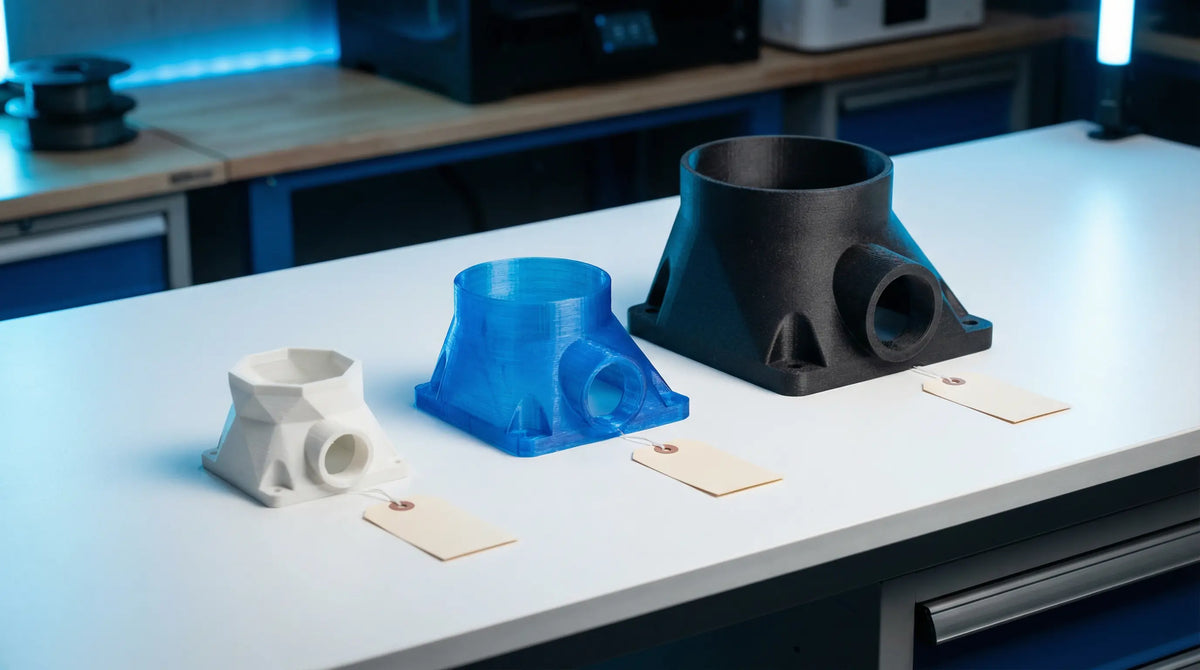
FDM 3D printing — materials from PLA to PA6-CF
- Emne
- 3D Print
- Metoder
- Guide · Materialer · Teknologi
- Materialer
- FDM
- Omfang
- 1685 ord · 9 min
PETG 3D printing — the versatile material for durable parts. ASA 3D printing — UV-stable for outdoor use. TPU 3D printing — flexible for seals and damping.
- FDM covers 80-90% of all technical plastic jobs at Maker Factory.
- Materials from inexpensive PLA to industrial PA6-CF, PC and ASA.
- Typically 2-4x cheaper than SLA for mechanical parts.
- Lead time 2-5 business days from a single piece — no minimum order.
- Free material advice and a fixed price within 24 hours.
Last updated: April 10, 2026 · Author: Henrik Beck, Maker Factory · 3D printing since 2013
FDM 3D printing — Fused Deposition Modeling — is the technology behind 80-90% of everything we print at Maker Factory. Not because it's the easiest solution, but because FDM is the right choice for the vast majority of technical jobs: faster than the alternatives, cheaper than metal and injection molding, and with a material range from simple PLA to carbon-fiber-reinforced PA6-CF. Read more about FDM technology, our general 3D printing service and the alternative SLA technology.
What is FDM 3D printing?
FDM melts plastic filament and lays it down layer by layer to build a finished part. The technology is the workhorse of the industry: simple, robust and incredibly flexible in material choice. At Maker Factory we primarily use Bambu Lab X1-Carbon printers with hardened steel nozzles — one of the market's fastest and most precise FDM platforms for business use. They print with layer heights down to 0.08 mm and are 3-5 times faster than earlier generations.
- The filament is heated and extruded — molten plastic is laid down precisely through a moving nozzle.
- Layer-by-layer build-up — the model is built from the bottom up, layer by layer, with internal structure (infill) that saves material.
- Post-processing — supports are removed, surfaces can be sanded, painted or acetone-vapor-smoothed depending on material.
That means shorter lead times and lower prices — without compromising on dimensional accuracy or material quality. See our technical FDM specifications for tolerances, build volume and machine data.
FDM materials — from PLA to PA6-CF
Standard materials
- PLA — the cheapest FDM material. Suited to prototypes and indoor use with no mechanical or heat requirements.
- PETG — our default choice for technical parts. Temperature-resistant up to 80°C, tougher and more chemically resistant than PLA.
- TPU 95A and TPU 65D — flexible, rubber-like materials for seals, dampers, grips and tubing.
Technical and industrial materials
- PA6-CF — carbon-fiber-reinforced nylon. High stiffness, low weight, heat-resistant up to 150°C. Our most used material for business customers.
- ASA — UV-stable and weather-resistant. The default choice for outdoor applications and signage.
- PC (Polycarbonate) — maximum impact strength and temperature resistance up to 120°C.
- ABS — good chemical resistance and easy post-processing with acetone vapor.
- PC-FR — flame-retardant PC for electronics, electrical installations and the rail industry.
- PETG-CF — carbon-fiber-reinforced PETG for light-technical parts with improved stiffness.
When do you choose FDM over SLA?
The choice between FDM and SLA isn't about which technology is "best" — it's about what the job requires. FDM is the right choice when mechanical strength, size, price and material range matter more than mirror-smooth surfaces. Here are the situations where FDM consistently delivers better results:
- Mechanically loaded parts — brackets, holders, structural parts and functional parts that need to carry load or withstand impact.
- Large parts — build volume up to 256 × 256 × 256 mm without joining. SLA is typically limited to smaller prints.
- Outdoor use — ASA and PETG withstand UV, rain and temperature swings. Resin degrades in sunlight.
- Heat-resistant components — PC up to 120°C, PA6-CF up to 150°C, High Temperature variants even higher.
- Flame-retardant parts — PC-FR for electronics, switchboard installations and the rail industry.
- Batches of 10 to 500 pieces — 2-4x cheaper per piece than SLA in most technical materials.
- Prototypes with functional requirements — when the prototype needs to be tested mechanically, not just presented.
- The part needs to carry load, flex or withstand impact
- The part is large (over roughly 15 cm) or needs batch production
- You need UV resistance, heat resistance or flame retardancy
- Price per piece matters more than a mirror-smooth surface
- The material needs to be an engineering plastic (PA6-CF, PC, ASA, PETG)
Mechanical strength and durability
If the part needs to flex, carry load or withstand repeated impact, FDM is almost always the right choice. PA6-CF and PC produce tough parts that can replace machined aluminum in many applications — at a fraction of the cost. Resin is sharp and beautiful, but also more brittle under impact and bending.
Large parts and batch production
Where SLA is typically limited to small, detailed parts, FDM can produce parts up to roughly a square meter in segments — and batches of 10-500 pieces with good per-piece economics. Injection molding tools cost DKK 50,000-200,000 and are only cost-effective at 1,000+ pieces. FDM delivers from a single piece with no tooling cost and full geometric freedom.
Outdoor and technical environments
While resin degrades in UV light and becomes brittle, ASA and PETG are developed specifically for outdoor use. Signage, drone parts, marine fittings and agricultural equipment are classic FDM applications. If there are requirements for heat above 80°C, fire ratings or chemical resistance, the FDM material library is far broader than SLA's.

FDM vs. SLA — comparison
| Property | FDM (filament) | SLA (resin) |
|---|---|---|
| Mechanical strength | Tough, high impact strength (PA6-CF, PC) | More brittle, lower impact strength |
| Max. size | 256 × 256 × 256 mm (larger in segments) | ~20 × 20 × 25 cm |
| UV resistance | Good (ASA, PETG) | Limited |
| Heat resistance | Up to 150°C (PA6-CF) | Up to 238°C (high-temp resin) |
| Detail level | Visible layer lines (0.08-0.3 mm) | Smooth, injection-molded-like |
| Material range | 10+ engineering materials | 8 resin types |
| Price per part | 2-4x cheaper than SLA | Higher |
| Best for | Functional parts, large geometries, batches, outdoor use | Detail, prototypes, miniatures, dental |
SLA wins on detail under 0.1 mm, transparent parts, jewelry models and medically certified materials. Read SLA 3D printing — precision and detail or the comparison FDM vs. SLA — which method suits your project?
Typical jobs we solve with FDM
- Industrial brackets and holders — PA6-CF or PC for machine building and automation.
- Prototypes with functional requirements — testing fit, strength and assembly before injection molding.
- Spare parts — on-demand production of discontinued or special components.
- Enclosures and housings — for electronics, sensors and installations.
- Tooling and jigs — assembly fixtures, drilling jigs and production tooling.
- Advertising and signage — ASA for UV-stable outdoor signage and displays.
We have experience with industry and manufacturing, machine building and automation, electronics and technology and advertising and events.
What does FDM printing cost at Maker Factory?
- PLA/PETG print, 20-80 g: DKK 100-250 per piece.
- ASA/ABS print, 50-150 g: DKK 200-500 per piece.
- PA6-CF print, 50-150 g: DKK 400-900 depending on geometry and infill.
- PC and PC-FR: surcharge of 20-30% over PETG.
- Batches of 10-100 pieces: volume discount — agreed individually.
- Design + print combined: bundled price, always cheaper than separate.
An analysis from 3D Printing Industry documents that additive manufacturing is competitive with injection molding up to 500-1,000 pieces in high-mix/low-volume production. Read more about pricing in general in What does 3D printing cost?
The most common mistake I see with FDM jobs is the wrong material choice. Customers ask for PLA for a part that will sit in a hot car, or ABS for a part that will stand outdoors. PLA softens at 60°C, ABS degrades in UV light. Call or email about the material before you order — it takes five minutes and saves you from having to reprint.
Need it printed in FDM? Upload your file or describe the job — we'll send a fixed price within 24 hours.
Get a quote for FDM printing →Frequently asked questions about FDM 3D printing
What is FDM 3D printing?
FDM (Fused Deposition Modeling) melts plastic filament and lays it down precisely layer by layer. It's the most widely used 3D printing method for technical plastic parts and industrial applications — and the technology we use for 80-90% of our production.
What materials can FDM print?
We print in PLA, PETG, PETG-CF, PA6-CF, ASA, ABS, PC, PC-FR, TPU-95A and TPU-65D. From simple prototypes to high-performance industrial components with requirements for heat, UV, chemical resistance or mechanical strength.
What does FDM 3D printing cost?
A simple PETG print starts from around DKK 100-150 per piece. PA6-CF typically costs DKK 400-900 depending on size and geometry. Send your STL and get a concrete quote within 24 hours — no obligation.
When is FDM better than SLA?
FDM is better for mechanically loaded parts, large parts, outdoor use and batches. FDM is typically 2-4 times cheaper than SLA and produces stronger parts in the vast majority of technical materials.
What's the lead time on FDM printing?
Standard lead time is 2-5 business days from an approved quote. For rush jobs: contact us directly — we prioritize urgent jobs when capacity allows.
Can you print in carbon-fiber-reinforced materials?
Yes. We print in PA6-CF and PETG-CF daily with our Bambu Lab X1-Carbon printers equipped with hardened steel nozzles. See our PA6-CF material page for specifications.
How large can you print?
Our standard build volume is 256 × 256 × 256 mm per part. Larger parts can be printed in segments and joined — contact us about dimensions.
Want to read more? See also SLA 3D printing — precision and detail and What does 3D printing cost?. Background on the technology on Wikipedia about Fused Filament Fabrication.
Mere fra Blog
 PC 3D printing — polycarbonate for heat and industrial parts
In short — PC (polycarbonate) 3D printing: PC is the strongest and most heat-resistant FDM material for technical parts —...
Læs artiklen →
PC 3D printing — polycarbonate for heat and industrial parts
In short — PC (polycarbonate) 3D printing: PC is the strongest and most heat-resistant FDM material for technical parts —...
Læs artiklen →
 3D printed jigs and fixtures — faster and cheaper than CNC
In short — 3D printed jigs and fixtures: 3D printed jigs and fixtures cost 5–20× less than CNC-machined aluminum and...
Læs artiklen →
3D printed jigs and fixtures — faster and cheaper than CNC
In short — 3D printed jigs and fixtures: 3D printed jigs and fixtures cost 5–20× less than CNC-machined aluminum and...
Læs artiklen →
 Nylon 3D printing — PA6-CF for industry and functional parts
In short — the key facts about nylon 3D printing: Nylon (polyamide) is the strongest FDM material for mechanically loaded...
Læs artiklen →
Nylon 3D printing — PA6-CF for industry and functional parts
In short — the key facts about nylon 3D printing: Nylon (polyamide) is the strongest FDM material for mechanically loaded...
Læs artiklen →